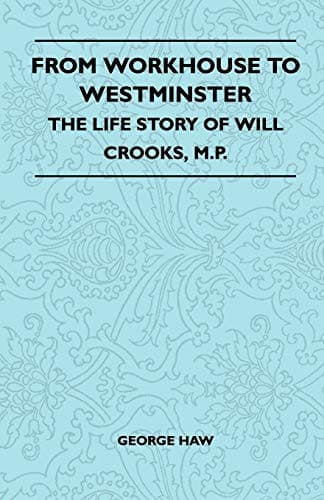
From Workhouse to Westminster: The Life Story of Will Crooks, M.P.Haw, George
History
From Workhouse to Westminster: The Life Story of Will Crooks, M.P.
Haw, George
Crooks, William, 1852-1921; Legislators -- Great Britain -- Biography; Social reformers -- Great Britain -- Biography
Crooks becomes a Grandfather--A Glimpse of his Home Life--Mr. G. R.
Sims on "A Morning with Will Crooks"--Crooks's Daily
Post-bag--Sample Letters--Speaking at Religious and Temperance
Meetings--On Adult Sunday Schools--On the Licensing Bill--A Homily
to Free Churchmen.
By this time Crooks had moved from Northumberland Street to Gough
Street, a few minutes' walk away. The change was from a five-roomed
house to a six-roomed house, "with exactly three and a half feet more
space for a garden at the back," as he jocularly described it.
His two eldest daughters had both married, and his eldest son, who was
doing well at the same trade his father learnt--that of cooper--had also
settled down to married life in Poplar. This son had the pleasure one
day of telephoning to his father at the County Council offices, just
after the latter had passed his fiftieth birthday, "You became a
grandfather this morning. Cheer up!"
Another daughter qualified at the Cheltenham Training College as a
school teacher. The youngest daughter elected to be "mother's right hand
at home." The youngest son was apprenticed in a Thames shipbuilding
yard.
Of his children he would often remark, during the controversy over
religious education in schools, that they seemed to disprove the
theories of both contending parties. One of his daughters and a son, who
were educated in Board Schools, became communicating members of the
Church of England, while two daughters educated in Church of England
schools afterwards became Nonconformists.
A glimpse of his home life was given in the "Celebrities at Home"
series, published in the _World_. The writer described Gough Street as a
row of tiny houses so much alike that the only difference between one
and another was the number on the door.
But if you did not know Mr. Crooks's number, you could guess his
house by waiting at the corner of the street. Because, between
half-past nine and half-past ten, the door-knocker of No. 81 will
beat a tattoo twelve or twenty times to the hour, when all the
other knockers are silent. For this is the hour when Mr. Crooks is
at home and receives his visitors, while he takes his breakfast in
a spasmodic and interrupted manner--bad, one feels sure, for his
digestion. They are not social callers. They come because they want
something--an order for free medicine or for an artificial limb,
for advice as to a likely quarter to get work, for a hundred and
one needs of poor people who have no resources of their own.
Public-domain text, read in full here on John Shaqi.
Reviews
Reviews
No reviews yet
Be the first to share your thoughts on this work.
Elsewhere in the archive
Join the Discussion
Join the discussion
Sign in to leave a comment or review.
Sign InorCreate an account