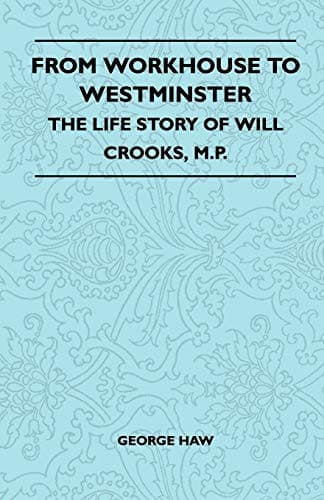
From Workhouse to Westminster: The Life Story of Will Crooks, M.P.Haw, George
History
From Workhouse to Westminster: The Life Story of Will Crooks, M.P.
Haw, George
Crooks, William, 1852-1921; Legislators -- Great Britain -- Biography; Social reformers -- Great Britain -- Biography
The need for giving out-of-work men proper training on the land was
being urged at the same time by Mr. John Burns. That winter, as chairman
of the Unemployed Conference called by the London County Council, Mr.
Burns and Canon Escreet, the vice-chairman, signed a report urging that
every opportunity should be taken to provide such training on the land
as would fit the workers for efficient labour. The report went on:--
Efforts in this direction are already made in the case of emigrants
to the Colonies, but it does not seem altogether reasonable that
special efforts should be made which would have the effect of
providing the colonies with specially trained labour if no efforts
in this direction are made on behalf of the Home Country. It is not
suggested that training for colonial life should not be provided,
but merely that the needs of the United Kingdom should be equally
borne in mind.
"I've seen wastrels," says Crooks, "who were going from bad to worse in
our back streets in Poplar regain health and strength when sent to our
farm at Laindon, and as they felt their muscles strengthening turn to
work like men. I have seen many a decent unemployed man tided over hard
times by being sent to work on our farm. The result of our first
winter's experiment was that twenty-five of the men emigrated to Canada,
the better for the training we had given them on the land. A dozen
obtained work on their own account. And then, as the winter passed and
trade got better, we began to discharge the men gradually. Over one
hundred of the discharged men have never asked for relief from the
Guardians since. If we had taken them into the workhouse at the time of
their destitution, as the Poor Law prescribes, the greater part of them
would have become permanent charges on the rates for the rest of their
lives."
This promising experiment was killed by the Local Government Board. The
Local Government Board refused to allow the farm to be continued except
as a branch workhouse. Mr. Fels, at the end of the three years' trial,
wrote to the Guardians:--
I desire to emphasise that my offer of the farm in the first
instance was not for the purpose of establishing a branch
workhouse, and in that way perpetuating stone yards, oakum picking,
and corn grinding, and other useless tasks, which seems to be all
the Local Government Board want to do.
On the contrary, I hoped that your Board would be allowed to try to
re-establish men who were down on their luck. I never for one
moment dreamed that your Board would be forced by the Local
Government Board to keep 150 men on one hundred acres of land, it
being obvious to me then, as now, that neither men nor staff could
have a chance in such conditions. Although the Local Government
Board has stifled this experiment, I am convinced that some such
Poor Law reform is bound to come.
Public-domain text, read in full here on John Shaqi.
Reviews
Reviews
No reviews yet
Be the first to share your thoughts on this work.
Elsewhere in the archive
Join the Discussion
Join the discussion
Sign in to leave a comment or review.
Sign InorCreate an account