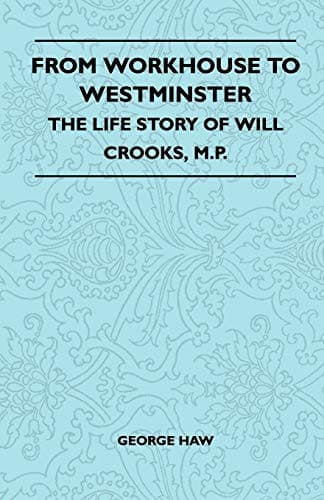
From Workhouse to Westminster: The Life Story of Will Crooks, M.P.Haw, George
History
From Workhouse to Westminster: The Life Story of Will Crooks, M.P.
Haw, George
Crooks, William, 1852-1921; Legislators -- Great Britain -- Biography; Social reformers -- Great Britain -- Biography
"In fact, the practical work a Minister of Labour could do is endless.
He could settle differences between masters and men before a strike was
thought of. To him could be referred disputes as to machinery, questions
as to safeguards, matters affecting hours, meal-times, overtime, and
women's work. He would be the most useful Minister in the Cabinet."
CHAPTER XXXI
THE REVIVAL OF BUMBLEDOM
Crooks's Poor Law Policy Attacked--How a Local Government Board
Inquiry was Conducted--Crooks's Mistake in Remaining Chairman of
the Board of Guardians--The Inspector's Report--Why the Poor Die
rather than go to Poplar Workhouse.
It is easy to understand that the humane spirit Crooks had infused into
Poor Law administration, and the fact of his having made the State
recognise a duty to the unemployed, was not acceptable to the old order
of Poor Law administrators, nor to some of the officials of the Local
Government Board.
When Crooks entered upon Poor Law work he found it bound hand and foot
by red tape. The men elected by the people did not rule at all. They
were little more than the servants of paid officials, whether in the
person of Bumble in the workhouse or of Bumble at the Local Government
Board.
We have seen how he fought against Bumble administration, and how
successive Presidents of the Local Government Board lent him their
support. Mr. Ritchie, at the request of Poplar, reduced the
qualification for Guardians. Sir Henry Fowler abolished it, and, again
at Poplar's request, deprived workhouse masters of the power to refuse
admission to Guardians. Mr. Henry Chaplin ordered "workhouse comforts"
and "adequate out-relief." Mr. Walter Long improved the dietary scale
and formed the Central Unemployed Committee. Mr. Gerald Balfour passed
the Unemployed Act.
All these reforms were more or less unwelcome to Bumbledom. One can
understand how impatiently those who stood for the old harsh order of
things waited for an opportunity to break into revolt. Their opportunity
came in June, 1906, at the Local Government Board Inquiry into Poplar's
Poor Law administration.
Crooks, who was still Chairman, courted the fullest and most open
investigation. Directly he heard that the Poplar Municipal Alliance was
making charges against the Guardians to the Local Government Board, he
appealed for a public Inquiry.
On the opening day of the public Inquiry at Poplar Crooks and his
colleague George Lansbury felt it to be their duty to protest against
its being conducted by an Inspector who, they alleged, had his verdict
in his pocket. They wished to make no reflection upon the Inspector's
personal integrity, but they declared then and afterwards that it
appeared to them to be "quite unjust to appoint so extreme an opponent
of their policy to conduct the inquiry."
Public-domain text, read in full here on John Shaqi.
Reviews
Reviews
No reviews yet
Be the first to share your thoughts on this work.
Elsewhere in the archive
Join the Discussion
Join the discussion
Sign in to leave a comment or review.
Sign InorCreate an account