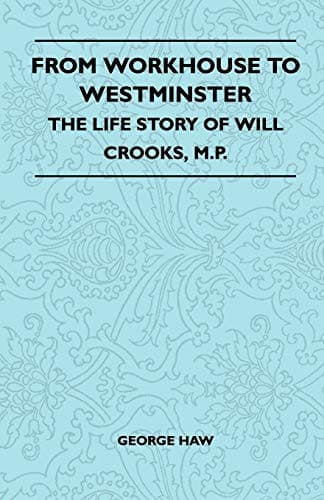
From Workhouse to Westminster: The Life Story of Will Crooks, M.P.Haw, George
History
From Workhouse to Westminster: The Life Story of Will Crooks, M.P.
Haw, George
Crooks, William, 1852-1921; Legislators -- Great Britain -- Biography; Social reformers -- Great Britain -- Biography
"I am sometimes told that I affect to despise my critics. You know
better, of course. But, really, after such experiences as these, I can't
help laughing at them when I think of their ponderous official
pronouncements against my policy and of the equally ponderous lectures
read to me by certain sections of the Press and the Church. When will
the Press and the Church, and 'all who are put in authority over us,'
come to learn what the mind of the people really is, and begin to
interpret it rightly? I know the heart of the people to be true. That is
why I laugh and go on my way confident that the little piece of
well-doing I have aimed at on behalf of the poor and the unemployed will
in the end put to 'silence the ignorance of foolish men.'"
If his meetings were inspiring, the same can be said of his
correspondence. Public men, in various parts of the country, including
Guardians, wrote to congratulate him on the brave stand he had made
against the forces of Bumbledom. From other quarters he had many
encouraging letters.
Canon Scott Holland wrote: "You know how your friends feel for you in
this cruel trouble. We need not tell you how we trust you, and believe
in you, and stand by you."
"You have made many lives happier and better by your work on behalf of
the poor," wrote a high official from a central Poor Law establishment.
"I thought it might be a comfort to you to know we feel indignant that
you have been rudely assailed."
It was encouraging also to receive a note from a prominent Woolwich
Conservative. The writer commenced by saying that although he was a
political opponent, and would continue to be so, he had the greatest
respect for Crooks personally, and wished to assure him that he did not
agree with the attacks that had been made on his Poor Law policy.
"Cheer up," came a message from the Rev. A. Tildsley, pastor of the
Poplar and Bromley Tabernacle. "Don't get off your high pedestal to go
down to your opponents' level. Leave the mud alone. The sun shines
daily, and will soon dry it. Then it will drop off itself. All good men
have to pay the price. This is not your first baptism of fire in defence
of the poor."
From the Oxford House Settlement, Bethnal Green, the Rev. H. S.
Woolcombe wrote:--"I am perfectly certain that this attack cannot do you
any permanent harm, and that you and Lansbury are both men too big to
let it abate your courage and determination to go on with your work."
Letters came to him from abroad long after the Inquiry. Unknown friends
in America, France, and other countries sent him sympathetic letters. He
told one of his Woolwich meetings--according to the report in the Labour
Party's weekly newspaper, the _Woolwich Pioneer_:--
Public-domain text, read in full here on John Shaqi.
Reviews
Reviews
No reviews yet
Be the first to share your thoughts on this work.
Elsewhere in the archive
Join the Discussion
Join the discussion
Sign in to leave a comment or review.
Sign InorCreate an account