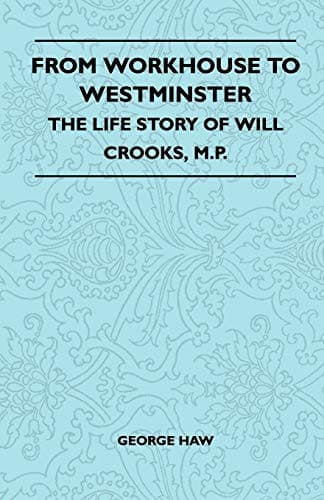
From Workhouse to Westminster: The Life Story of Will Crooks, M.P.Haw, George
History
From Workhouse to Westminster: The Life Story of Will Crooks, M.P.
Haw, George
Crooks, William, 1852-1921; Legislators -- Great Britain -- Biography; Social reformers -- Great Britain -- Biography
But the Government had learnt by this time that a departmental blunder
had been committed by associating the Poor Law policy of Crooks with the
faulty administration of some of his colleagues. The Prime Minister got
out of the difficulty by informing the House that the report was not
made by the Local Government Board, but to that Board by one of their
officers, "and," he added, "I don't understand that it is proposed to
call in question any action of my right hon. friend the President in
regard to the report."
Indeed, the President of the Local Government Board assured a friend of
Crooks in a conversation in the Lobby that there had been a
misunderstanding somewhere. He sought an early opportunity of giving
Crooks a similar assurance.
It was said of Crooks in Poplar about that time that he was going to
leave the neighbourhood never to return. Working-men came round to him
in solemn deputation, and women and children stopped him in the street,
in order to hear from his own lips that the bodeful rumour bore no
meaning. The rumour, which never had the smallest basis of truth,
reached the workhouse, where he had not been seen for two or three
weeks, weighed down as he was by a hundred public attacks, his own
wearing illness and a heavy domestic trouble. But one afternoon he found
time to go and see the inmates again. And old men hobbled towards him
and clutched his arm and hand as they broke down in their efforts to
tell him what was in their hearts. When he entered the women's wards
there was a chorus of almost tearful appeals. "Say it isn't true, Mr.
Crooks." "Don't go away and leave us, Mr. Crooks."
Sitting alone at the end of a bench was one old dame talking to herself
in that vague, mumbling way common to many old women in our workhouses.
As she rambled on in her talk she took up the cry:--
"Don't leave us, Mr. Crooks. For over seventy years I worked hard, Mr.
Crooks, ever since I was eight years of age. Brought up a family of
ten--two boys died in the wars, one drowned at sea. All the others left
me long ago, and I don't know where they are. And my man was buried in
'eighty-nine--buried near the brickfields where we worked together
thirty years before. And I kept myself outside for fifteen years, a lone
old woman; and you helped me, Mr. Crooks, until I couldn't look after
myself any longer, and then you made me comfortable here. So now I count
the days between your coming to see us to cheer us up. So please don't
leave us, Mr. Crooks. Don't--don't leave us, Mr. Crooks."
CHAPTER XXXIII
"THE HAPPY WARRIOR"
A Cheerful Invalid and his Neighbours--The Starving Children in the
Schools--Public Confidence in Crooks--Left Smiling.
Shortly afterwards he was laid low for two or three weeks, the victim of
his old enemy, muscular rheumatism.
"Some of my ancestors must have been aristocrats," he used to tell his
visitors good-naturedly from his sick bed in explanation of his
recurring complaint.
Public-domain text, read in full here on John Shaqi.
Reviews
Reviews
No reviews yet
Be the first to share your thoughts on this work.
Elsewhere in the archive
Join the Discussion
Join the discussion
Sign in to leave a comment or review.
Sign InorCreate an account