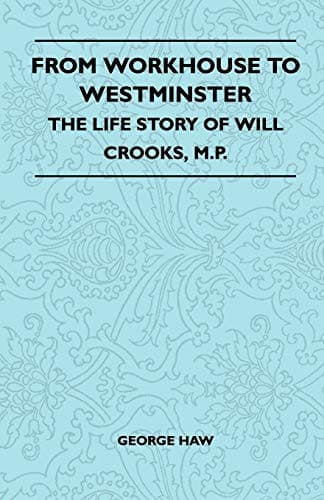
From Workhouse to Westminster: The Life Story of Will Crooks, M.P.Haw, George
History
From Workhouse to Westminster: The Life Story of Will Crooks, M.P.
Haw, George
Crooks, William, 1852-1921; Legislators -- Great Britain -- Biography; Social reformers -- Great Britain -- Biography
Those who heard Mr. Crooks's speech in the Council Chamber, when
the subject of the training of Poor Law children came up on a side
issue, will not readily forget it. One of the daily papers, in its
admiration the next day, declared it to be the best speech heard at
the Council. Be that as it may, the speech, coming spontaneously
with the pent-up indignation of a soul that had suffered sorely
from a pernicious system, was a marvellous one, producing a
marvellous effect. Councillors in the front benches turned round
and visitors in the gallery stretched forward to catch a glimpse of
the short dark figure on the Labour bench pleading so powerfully
for the children of the poor.
Nor had he been in the House of Commons long before his voice was heard
there on behalf of workhouse children. Speaking in a debate in 1903 on
the various methods of dealing with these children, he said:--
At one time there was no stronger advocate of boarding-out than
myself. It is an ideal system in theory, but its success by
practical application has yet to be proved. Many requests are made
by country people to be allowed to adopt children on charitable
grounds, but when inquiries come to be made into the incomes of
these people the Guardians generally find it is hoped to make a
profit out of the children. I have visited a village where a widow
boarded four children--two more than the law allows. For these
children she was paid sixteen shillings a week. She lived in a
district where the labourer's wages were only eleven shillings.
In regard to another case I personally investigated, I asked how
the boy was getting on.
"Oh, all right; but he is growing so big and eats such a lot that I
wish you would take him away and send me a smaller boy."
The boarded-out children, so far from losing the pauper taint, are
more frequently known by the name of the Union from which they
come than by their own names. In fact, in some villages, I found
"boarding-out" a staple industry. Boarding-out is all right in good
homes; the difficulty is to find good homes.
Not long after he made this speech, there was an outcry in a section of
the Press over "an amazing example of extravagance" at Poplar. It
appeared in the form of a letter from a correspondent. The
correspondent--who turned out to be a member of a firm of
contractors--waxed virtuously indignant over the Guardians' tenders
because they included, he alleged, supplies of luxuries for paupers. The
so-called luxuries for the most part proved to be medical comforts
ordered by the doctor for the ailing. Among the other items was 1 cwt.
of pat-a-cake biscuits, and these were singled out specially as a
specimen of how the workhouse inmates were pampered.
I met Crooks in the Lobby of the House of Commons at the time of the
outcry, and asked what he thought of it all.
Public-domain text, read in full here on John Shaqi.
Reviews
Reviews
No reviews yet
Be the first to share your thoughts on this work.
Elsewhere in the archive
Join the Discussion
Join the discussion
Sign in to leave a comment or review.
Sign InorCreate an account