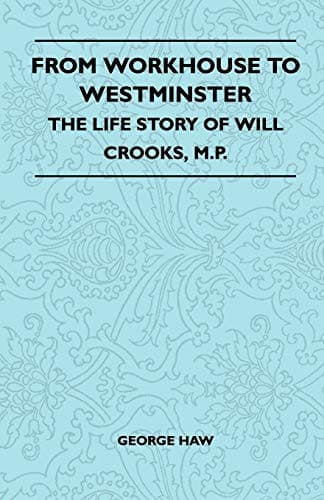
From Workhouse to Westminster: The Life Story of Will Crooks, M.P.Haw, George
History
From Workhouse to Westminster: The Life Story of Will Crooks, M.P.
Haw, George
Crooks, William, 1852-1921; Legislators -- Great Britain -- Biography; Social reformers -- Great Britain -- Biography
As already shown, Mr. Chaplin declared emphatically for the Poplar
policy. His notable circular to Poor Law Guardians, for which as
President of the Local Government Board he will perhaps be best
remembered, gave the support of the Government of the day to that policy
of humane administration of the Poor Law which Crooks had established at
Poplar. It laid down three principles which the Labour man had urged
upon the President at their first meeting:--
1. Children to be entirely removed from association with the
workhouse and workhouse surroundings.
2. Old people of good character who have relatives or friends
outside not to be forced into the workhouse, but to be given
adequate out-relief.
3. Old people in the workhouse of good behaviour to be provided
with additional comforts.
Mr. Chaplin further showed his confidence in the Labour Chairman of the
Poplar Guardians by inviting him to become one of the Local Government
Board's representatives on the Metropolitan Asylums Board. The work
meant a heavy addition to Crooks's public duties, with the London County
Council and the Poplar Guardians demanding so much of his time. There
was no hesitation, however, in accepting the new office when he found it
afforded further opportunities to serve the afflicted poor and help
neglected children. Mr. Chaplin's successor at the Local Government
Board, Mr. Walter Long, twice re-nominated Crooks to the same position.
Although the Asylums Board comes but little before public notice, except
in times of epidemic, it has far-reaching powers. It is the largest
hospital authority that any country can show. It has fourteen infectious
disease hospitals with accommodation for nearly seven thousand people.
It maintains six thousand imbecile patients in four asylums. It looks
after the welfare of several hundred boys on a Thames training-ship, and
of some two thousand children in various homes.
The members, or "managers," as they are called, are all nominated either
by London Boards of Guardians or by the Local Government Board. An
indirectly elected body is the last that expects to see a representative
of Labour. Imagine, therefore, the amazement of this somewhat select
company when, in May, 1898, a Labour man walked into their midst as the
nominee of a Conservative Cabinet Minister.
He was eyed at first with suspicion. The suspicion soon changed to
curiosity. The Labour man never spoke. The managers expected a torrent
of loud criticism, and here was immovable silence. For the first five
months Crooks never opened his mouth at the Board meetings.
"What's your game?" asked a friendly member in an aside one afternoon.
"I'm learning the business," was the quiet reply. "This is an old
established Board with notions of its own, and it's not going to be
dictated to by new-comers. But you wait, my friend, and you'll find
before long I'll be getting my own way in everything here."
Public-domain text, read in full here on John Shaqi.
Reviews
Reviews
No reviews yet
Be the first to share your thoughts on this work.
Elsewhere in the archive
Join the Discussion
Join the discussion
Sign in to leave a comment or review.
Sign InorCreate an account