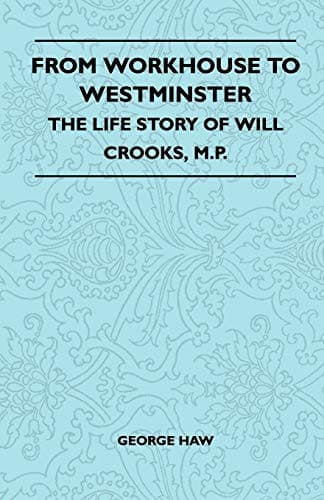
From Workhouse to Westminster: The Life Story of Will Crooks, M.P.Haw, George
History
From Workhouse to Westminster: The Life Story of Will Crooks, M.P.
Haw, George
Crooks, William, 1852-1921; Legislators -- Great Britain -- Biography; Social reformers -- Great Britain -- Biography
Other children under the Board's care might be said to suffer from an
excess rather than from a lack of intelligence. On the Asylums Board
they are known as remand children. In the police courts they are known
as first offenders. They consist of boys and girls who, having been
charged before a magistrate with offences which render them liable to be
sent to an industrial or a reformatory school, get remanded for
inquiries.
At one time, pending the inquiries, these youthful offenders used to be
detained in prison. When Crooks joined the Asylums Board they had been
transferred to the workhouse. The influence for evil was little better
in the one place than in the other. The one introduced them to
criminality, the other to pauperism.
"These children want keeping as far as possible from both prison and
workhouse," argued Crooks with his colleagues. "We ought to put them in
small homes and give them school-time and playtime, like other children,
until their cases come before the magistrate again."
So two or three dwelling-houses were taken in different quarters of
London and adapted as Remand Homes. Crooks headed a deputation from the
Asylums Board to the London magistrates at Bow Street to urge them in
future to commit all remand children to the Homes. The magistrates were
sympathetic enough, but showed it was their duty to carry out the law,
and that the law clearly laid it down that youthful offenders under
remand must be sent to the workhouse.
"We'll alter the law, then," was Crooks's reply. "For I'm determined
these youngsters shall no longer be sent to the workhouse."
In the record time of six weeks the law was altered. It sounds
miraculous to those who know the ways of Whitehall. Crooks's resource
proved more than equal to red-tapeism.
First the Asylums Board wrote to the Home Office. Then the Home Office
sent the usual evasive reply. The correspondence would have gone on
indefinitely had not Crooks waited on the Home Secretary in person.
As the Labour man expected, Mr. Ritchie knew nothing about the matter,
the Home Office officials having settled it without consulting the
Secretary of State. Always willing to co-operate in anything that
promised to keep children away from the workhouse, Mr. Ritchie asked
Crooks what he had to suggest. The visitor pointed out that the Juvenile
Offenders' Bill was at that very moment before Parliament, and that the
insertion in that measure of an additional clause of half a dozen lines
only would keep remand children away from the workhouse for all time.
The Home Secretary seized the idea at once, and Crooks's suggestion
became law the following month.
The first of the Remand Homes was opened at Pentonville Road for the
convenience of children charged at the police courts of North London and
the East-End. Sometimes as many as fifty young offenders, boys and
girls, can be seen there at the same time.
Public-domain text, read in full here on John Shaqi.
Reviews
Reviews
No reviews yet
Be the first to share your thoughts on this work.
Elsewhere in the archive
Join the Discussion
Join the discussion
Sign in to leave a comment or review.
Sign InorCreate an account