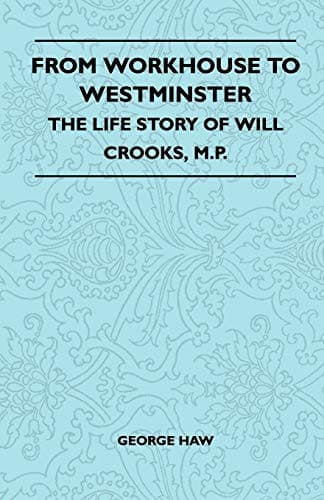
From Workhouse to Westminster: The Life Story of Will Crooks, M.P.Haw, George
History
From Workhouse to Westminster: The Life Story of Will Crooks, M.P.
Haw, George
Crooks, William, 1852-1921; Legislators -- Great Britain -- Biography; Social reformers -- Great Britain -- Biography
The English democracy is the most humorous democracy in the world.
The Scotch democracy is the most dignified, while the whole
_abandon_ and satiric genius of the English populace come from its
being quite undignified in every way. A comparison of the two types
might be found, for instance, by putting a Scotch Labour leader
like Mr. Keir Hardie alongside an English Labour leader like Mr.
Will Crooks. Both are good men, honest and responsible and
compassionate, but we can feel that the Scotchman carries himself
seriously and universally, the Englishman personally and with an
obstinate humour. Mr. Keir Hardie wishes to hold up his head as
Man, Mr. Crooks wishes to follow his nose as Crooks. Mr. Keir
Hardie is very like a poor man in Walter Scott. Mr. Crooks is very
like a poor man in Dickens.
A little incident bears out Mr. Chesterton to the letter. While Crooks
was showing a party of titled people at their request round some of the
dark corners of Poplar he was greeted as usual by all the children
playing in the streets. Seizing the blackest of them he presented the
youngster to one of the ladies of the party, a well-known peeress.
"If this little chap," said he, "was as clean as I could wash him and as
well dressed as you could dress him, what difference would there be
between him and a little prince?"
After the party had finished their round of inspection somebody
suggested tea.
"It's no use looking for swell tea shops in Poplar," said Crooks. "But
if you care to come with me, my wife will just be getting tea ready for
the children coming home from school, and no doubt we can find a corner
for you at the same table."
And straightway he led them to Northumberland Street and into his own
house without warning, where they shared with the children at the deal
table in the kitchen.
Sometimes for whole weeks together in the black days of distress he
could never finish his breakfast without being called to the door to
advise an out-of-work man or some sorrow-laden woman, or to deal with
some case of starvation that brooked no delay.
Of course he often defied the laws of political economy. That is
sometimes the only way to prevent people dying from want. A learned
professor of political economy, whose name I am not at liberty to
mention, was converted to some part at least of Crooks's view in a
single morning. The Professor called on him during a winter of hard
times, and Crooks showed him how some of his neighbours were living.
"Hunger we can sometimes stand, 'cos we gets used to it," they heard
from one woman, surrounded in her bare tenement by lean and shivering
babies; "but to be frozen with cold on the top of the hunger--that's the
thing that makes yer squirm, guv'nor--ain't it, Mr. Crooks?"
Then the Labour man led the Professor to a slum court. On the muddy
ground in the far corner a woman sat weeping.
Public-domain text, read in full here on John Shaqi.
Reviews
Reviews
No reviews yet
Be the first to share your thoughts on this work.
Elsewhere in the archive
Join the Discussion
Join the discussion
Sign in to leave a comment or review.
Sign InorCreate an account