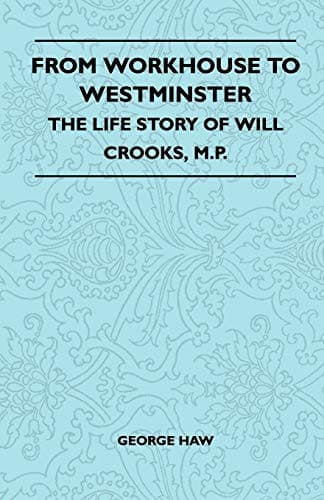
From Workhouse to Westminster: The Life Story of Will Crooks, M.P.Haw, George
History
From Workhouse to Westminster: The Life Story of Will Crooks, M.P.
Haw, George
Crooks, William, 1852-1921; Legislators -- Great Britain -- Biography; Social reformers -- Great Britain -- Biography
Meanwhile, the tension had become too much for some burly working-men in
the public gallery. They could be heard blubbering. When you looked up
you saw them mopping their grimy faces with red-spotted handkerchiefs
or the ends of their scarfs.
These men, with many of their mates, had crowded into the Council
Chamber on their way home from the engineering yards and railway goods
sidings in Millwall and from all the neighbouring docks. Those who could
not get inside formed a dense crowd in the streets below. As the news
was brought out from time to time, how two ballots had been taken and
the votes were still equal, a silence strange and solemn fell upon the
massed crowds surging round the Municipal Buildings in the lamp-lighted
streets.
Soon the silence gave way to a roar of working-men's voices.
"Crooks has got it!"
"Our Will's made Mayor!"
"God bless the Mayor!"
Among that rough-jacketed company could be seen men falling on each
other's necks. And as they streamed homeward in all directions the
streets of Poplar echoed with the cry that lingered far into the night,
"Will Crooks is Mayor!"
He was the first Labour Mayor in London. As such he did not make the
mistake of trying to fill the office like the ordinary middle-class man.
He faced all the world essentially as a working-man Mayor. He showed how
well a workman can carry out the administrative and ceremonial duties
inseparable from the office. In doing that he dispelled for ever the old
illusion that only men of means can become mayors.
"What d'yer think?" he overheard a tradesman's wife ask another in
disgust. "They've made that common fellow Crooks Mayor! And he no better
than a working-man."
"Quite right, madam," he interposed, raising his hat as she turned
round, crimson, and recognised him. "No better than a working-man!"
It was evident, too, that at first certain of the other metropolitan
mayors thought him a common fellow, far beneath their notice. The first
occasion that saw him in their midst was a conference of mayors at the
Mansion House. It was convened by the Lord Mayor to consider
arrangements for the Coronation Dinner to the Poor. Crooks listened for
an hour to all kinds of suggestions put forward by men who knew little
about the poor before rising at last to make a proposal of his own.
The instant he rose there was a howl of disapproval.
"Sit down--sit down!" "Who are you?" "We want none of your opinions."
"Sit down--sit down!"
The wrath of some of these funny little functionaries at the idea of a
Labour man daring to address them was something he laughed at for a long
time after. Several of them had lost their heads entirely at being
invited to discuss a matter which so closely concerned the King and
Queen. The very presence of a Labour man at such an august gathering was
felt to be an insult.
Public-domain text, read in full here on John Shaqi.
Reviews
Reviews
No reviews yet
Be the first to share your thoughts on this work.
Elsewhere in the archive
Join the Discussion
Join the discussion
Sign in to leave a comment or review.
Sign InorCreate an account