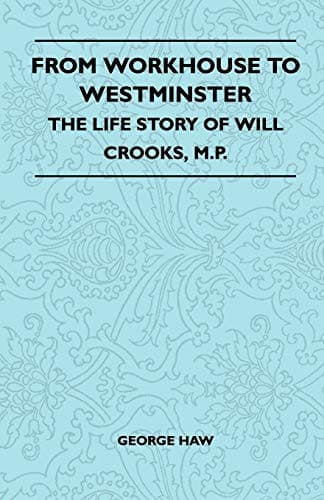
From Workhouse to Westminster: The Life Story of Will Crooks, M.P.Haw, George
History
From Workhouse to Westminster: The Life Story of Will Crooks, M.P.
Haw, George
Crooks, William, 1852-1921; Legislators -- Great Britain -- Biography; Social reformers -- Great Britain -- Biography
"Now I for one have got tired of waiting. I've commenced to pay
pensions already. I maintain that it is both lawful, and right to pay
pensions through the Poor Law. And I intend to go on paying them, and to
urge others to pay them, until Liberal and Conservative politicians
cease deluding the people by promises and establish a State system."
He put forward his scheme before many other assemblies. To the argument
that this is only a system of "glorified out-relief," he makes answer,
"So are most pensions. At the risk of outraging the feelings of
economists, I hold that out-relief to the poor is no more degrading than
out-relief to the rich. We hear no talk of endangering the independence
of Cabinet Ministers or of Civil Servants when they are paid old age
pensions.
"It is argued the poor have the workhouse provided for them. True; but
was it not Ruskin who pointed out that--
The poor seem to have a prejudice against the workhouse which the
rich have not; for, of course, everyone who takes a pension from
Government goes into the workhouse on a grand scale; only the
workhouses for the rich do not involve the idea of work, and should
be called playhouses. But the poor like to die independently, it
appears. Perhaps, if we make the playhouses pretty and pleasant
enough, or give them their pensions at home, their minds might be
reconciled to the conditions.
"Look down as you may on these veterans of almost endless toil, but
don't forget they have made our country what it is. They have fought in
the industrial army for British supremacy in the commercial world and
obtained it. The least their country can do is to honour their old
age."
The twofold character of Crooks's Poor Law policy has already appeared.
While he wants to make life in the workhouse less like life in prison,
he is also anxious that all worn-out old men and women, who have friends
to look after them, should be kept as far from the workhouse as
possible.
"To do that means the granting of a pension. Call it outdoor relief if
you like, but at the same time call the Right Honourable Gerald
Balfour's and Lord Eversley's pensions outdoor relief.
"At any rate, relief must be on a more generous scale than it usually is
if you are going to keep honourable old people out of the workhouse.
Failing that, out-relief has a tendency to perpetuate sweating. Mr.
Chaplin was not alone in deprecating inadequate out-relief. The Aged
Poor Commission, of which the King was a member, reporting in 1895,
called attention to the ill-effects of inadequate out-door grants and
suggested that the amounts be increased."
Public-domain text, read in full here on John Shaqi.
Reviews
Reviews
No reviews yet
Be the first to share your thoughts on this work.
Elsewhere in the archive
Join the Discussion
Join the discussion
Sign in to leave a comment or review.
Sign InorCreate an account