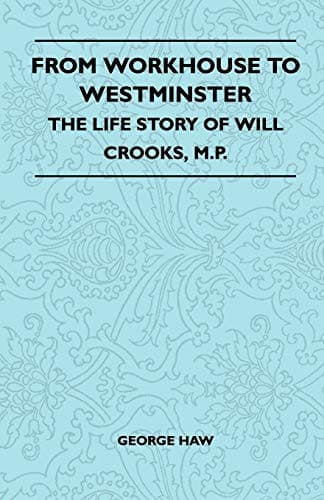
From Workhouse to Westminster: The Life Story of Will Crooks, M.P.Haw, George
History
From Workhouse to Westminster: The Life Story of Will Crooks, M.P.
Haw, George
Crooks, William, 1852-1921; Legislators -- Great Britain -- Biography; Social reformers -- Great Britain -- Biography
Nobody but the little band of Labour men in the constituency believed in
Crooks's chances. The honours had fallen so easily hitherto to the
Conservatives. Lord Charles Beresford got the seat without a contest.
Sir Edwin Hughes before him was returned unopposed in 1900, while for
sixteen years previously he held the seat by majorities averaging more
than two thousand. The majority at the previous contest (which took
place in 1895) reached 2,805.
Faced with this formidable figure, Crooks entered upon the contest with
all his usual zeal and good humour. There was first the difficulty of
the election expenses. The Labour Association quickly raised £200 from
among its members. It soon became evident, however, that before the
Labour Party could get in touch with the sixteen thousand voters on the
register and meet the returning officer's fees, a sum four or five times
as large as that would be needed.
An appeal to the public was sent out by the Association, signed by S. H.
Grinling, M.A. (chairman), W. Barefoot (treasurer), and A. Hall
(secretary). The appeal was taken up by the _Daily News_, which opened a
Woolwich Election Fund. In about a fortnight that paper raised £1,000.
Contributions poured in from all classes, in every part of the kingdom,
accompanied by a chorus of well-wishes of which any public man might
indeed be proud.
As from day to day the amounts were acknowledged in the _Daily News_,
one saw side by side with the modest two shillings from "Four workers"
£10 from Lord Portsmouth. Among the shillings and sixpences from working
women and girls appeared £5 from Lady Trevelyan, and a list of
subscriptions from Father Adderley, containing one "From a lady in lieu
of a new hat." The day "Two Chalfont lads" sent "a bob each," two sums
of £50 were acknowledged from the Right Hon. Sydney Buxton and Mr.
George Cadbury. The authors of "The Heart of the Empire," with a gift of
£25, shared the same spirit with "A Leominster working-man," who
forwarded three shillings, and "Four working men of Cirencester," who
sent four shillings between them. Dr. Clifford, the Rev. Stopford
Brooke, and Canon Scott Holland swelled the list, together with old
Labour Members of Parliament like Mr. T. Burt and Mr. H. Broadhurst.
"A fellow worker of Mr. Crooks on the Asylums Board" was responsible for
£10, while colleagues of his on the London County Council contributed
about £100 between them.
From Porchester Square came a substantial cheque with an unsigned note
written in the third person, to this effect:--
The lady who sends the enclosed is nearly eighty-four, and
therefore cannot offer any help in person, but she most heartily
wishes Mr. Crooks success in his brave fight, as she has for a long
time past desired to see more Labour representatives in the House
of Commons.
Public-domain text, read in full here on John Shaqi.
Reviews
Reviews
No reviews yet
Be the first to share your thoughts on this work.
Elsewhere in the archive
Join the Discussion
Join the discussion
Sign in to leave a comment or review.
Sign InorCreate an account