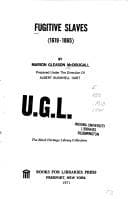
Fugitive Slaves (1619-1865)McDougall, Marion Gleason
History
Fugitive Slaves (1619-1865)
McDougall, Marion Gleason
Fugitive slaves -- United States; Slavery -- Law and legislation -- United States
"Preamble. Whereas it is the duty of the Congress of the United States
to enact all laws necessary to enforce such provisions of the
Constitution as were intended to protect the citizens of the several
States in their rights of property, and past experience has proved that
laws should be passed by Congress to enforce the second section of the
fourth article of the Constitution, which requires that persons held to
labor in one State, escaping into another, shall be delivered up on
claim of the party to whom such labor may be due; therefore, Resolved,
That the Committee on the Judiciary is hereby instructed to report a
bill to this House, providing effectually for the apprehension and
delivery of fugitives from labor who have escaped, or may hereafter
escape, from one State into another." Rules not suspended.--_House
Journal, 30 Cong. 3 Sess., 213; Cong. Globe, 30 Cong. 2 Sess., 188._
=30. Legislative history of the Fugitive Slave Act. [Jan. 3 to Sept. 18,
§ 29.]=
=1850, Jan. 3.= Mr. Mason of Virginia gave notice of his intention to
introduce a bill.--_Cong. Globe, 99._
=Jan. 4.= Senate bill No. 23 introduced by Mason, read twice, ordered
printed, and referred to the Committee on the Judiciary.--_Senate
Journal, 54; Globe, 103._
=Jan. 16.= Bill reported favorably by Butler from the committee, ordered
printed, and made a special order for Jan. 23.--_Senate Journal, 88;
Globe, 171; Senate Reports, I. No. 12._
=Jan. 22.= Debate begun. Mason offered an amendment which made the fine
for any obstruction of the workings of the act one thousand dollars, and
refused to allow the testimony of a fugitive.--_Globe_, 210.
=Jan. 23, 24.= Bill taken up and debated.--_Senate Journal_, 104, 110;
_Globe_, 220, 228; _Globe App._ 79, 83.
=Jan 28.= Seward presented an amendment, which allowed the right of
trial by jury, and punished judges who should disallow the writ of
habeas corpus.--_Senate Journal_, 117; _Globe_, 233-237.
=Jan. 29.= Clay introduced, as a part of his compromise resolutions, a
declaration that a more effective fugitive slave act should be
passed.--_Senate Journal_, 118; _Globe_, 247.
=Jan. 31.= Mason offered a substitute for the bill already before the
Senate. It was laid on the table, and ordered to be printed.--_Globe_,
270.
=June 3.= Webster brought in an amendatory bill.--_Senate Journal_, 370;
_Globe_, 1111.
=Aug. 15.= The debate was again opened, and made the special order for
Aug. 19.--_Senate Journal_, 560; _Globe_, 1588.
=Aug. 19.= Mason offered as an amendment a substitute for the bill
already before the Senate.--_Senate Journal_, 564; _Globe_, 1605; _Globe
App._, 1582.
Dayton brought in an amendment which gave trial by jury. This was
rejected.--_Senate Journal_, 564; _Globe App._, 564.
Chase offered one of the same character, which was also
rejected.--_Globe App._, 1589.
Winthrop brought in an amendment granting the protection of the habeas
corpus. This was rejected.--_Senate Journal_, 565; _Globe App._, 1589.
Public-domain text, read in full here on John Shaqi.
Reviews
Reviews
No reviews yet
Be the first to share your thoughts on this work.
Elsewhere in the archive
Join the Discussion
Join the discussion
Sign in to leave a comment or review.
Sign InorCreate an account