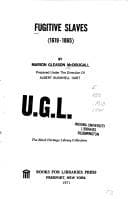
Fugitive Slaves (1619-1865)McDougall, Marion Gleason
History
Fugitive Slaves (1619-1865)
McDougall, Marion Gleason
Fugitive slaves -- United States; Slavery -- Law and legislation -- United States
Out of the great variety of original sources containing descriptions of
slave life and escapes, the autobiographies of the slaves themselves are
the most interesting, and often the saddest. The Rev. James Freeman
Clarke says, in his Antislavery Days: "Even now, when it is all over, the
flesh creeps and the blood curdles in the veins at the accounts of the
dreadful cruelties practised on slaves in many parts of the South. I
would advise no one to read such histories to-day unless his nerves are
very well strung." _Frederick Douglass_ has given us two books, one
written before slavery was abolished, and a fuller account afterward,
when it was no longer imprudent to reveal the whole story of his escape.
Many of these lives were published by antislavery people, who wished by
such means to rouse the North. Such are the stories of _Box Brown_,
_Peter Still_, _Archy Moore_, _Solomon Northrup_, _Lunsford Lane_, and
others, most of which have been quoted above.
=7. Records of trials.=
Much descriptive detail can often be found in the published reports of
trials. A volume is devoted to the Oberlin-Wellington case, and several
volumes have been published on the Burns trial. For the Prigg and Hanway
cases, and others of importance, the records of the Supreme Court and
lower courts have been consulted. Most of the important cases were tried
in State courts or before commissioners, and the only reports are
fugitive pamphlets, of which many have been consulted and cited.
=8. Speeches.=
In the study of public sentiment and for the weighing of argument the
speeches of _Phillips_, _Sumner_, _Seward_, _Giddings_, _Webster_,
_Mann_, _Rantoul_, _Loring_, and others, are of the greatest value. They
often throw light upon obscure cases, and the fugitive slave stories
brought in as illustrations have sometimes led to the discovery of
interesting and forgotten cases.
=9. Reminiscences.=
A valuable aid in reconstructing in the mind the conditions of the
slavery struggle are the reminiscences of participants. _Rev. James
Freeman Clarke's Antislavery Days_ and _Mr. Parker Pillsbury's_ book have
been helpful in these chapters. A pamphlet by _Mr. Austin Bearse_
describes the Fugitive Slave Laws in Boston, and relates the work of the
Vigilance Committee in protecting escaped negroes. The books of _Still_,
_Smedley_, and _Coffin_, on the workings of the Underground Railroad, are
composed chiefly of reminiscences, and have furnished many essential
facts.
=10. Reports of societies.=
The reports of the various antislavery societies, especially of those of
Massachusetts and Pennsylvania, have also been examined with profit as to
the work among the refugees in Canada, etc. For the colonial period the
publications of the Massachusetts and New York Historical Societies are
exceedingly important, and have been freely drawn upon.
=11. Periodicals and newspapers.=
Public-domain text, read in full here on John Shaqi.
Reviews
Reviews
No reviews yet
Be the first to share your thoughts on this work.
Elsewhere in the archive
Join the Discussion
Join the discussion
Sign in to leave a comment or review.
Sign InorCreate an account