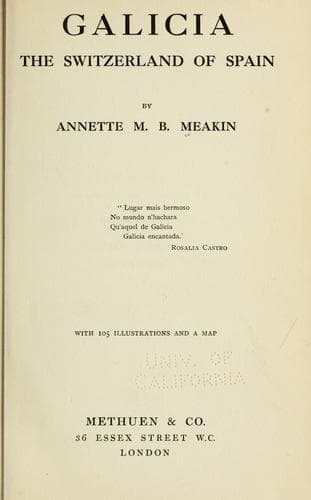
Galicia, the Switzerland of SpainMeakin, Annette M. B.
History
Galicia, the Switzerland of Spain
Meakin, Annette M. B.
Galicia (Spain : Region)
A masterpiece like the _Pórtico de Gloria_, dating a century, or even
half a century, later would cause less surprise, but how it comes about
that such a finished and perfect _chef d’œuvre_ could have been
accomplished at so early a date and in such an out-of-the-way part of
the civilised world--is a puzzle.[164] Frenchmen ply their pens with
vigour to prove that Master Matthew was a native of _la belle France_.
Spaniards are equally energetic in their assertions that he was a native
of Spain, and some even go so far as to say that he must have been a
native of Galicia. “There is as yet nothing to prove that Mateo was not
a Gallegan,” writes Lopez Ferreiro. “He lived at Santiago, or at least
in Galicia, from 1161 to 1217, to say the very least; and it is thought
that he was born and educated in Galicia. He was a layman, with a wife
and children.”--And as this writer is one of Spain’s greatest living
historians as well as a famous archæologist, his opinion has weight. He
tells us that from the end of the eleventh century there flourished in
Santiago a school of artists for all branches of art--an institution
which was the means of producing marvellous results. To begin with, it
produced the cathedral itself, and at the same time it produced the most
exquisite specimens of silver and copper workmanship. This school was
enriched, in 1135, by Alfonso VII., with many privileges, which were
also enjoyed by later generations of artists. There still exists a
diploma given to Mateo by Ferdinand, King of Leon, on 23rd February
1168. This king, on the occasion of a royal pilgrimage to the sepulchre
of St. James, granted Mateo a pension of 4200 pesetas (or francs) a
year. It seems that Mateo started the work at once, and took twenty
years to accomplish it; during those twenty years the Gothic style of
architecture had been slowly gaining ground. We see it in the elegant
vaulting of the _Pórtico_ and in its graceful groining.
_The Historia Compostelana_ contains not a single allusion to the
Pórtico de Gloria, which does not seem to have been even planned at the
time that manuscript was written.
CHAPTER X
SCULPTURED CAPITALS
Favourite subjects--Plain capitals in English cathedrals--The
foliage--The trumpet pattern--Capitals in the gallery--New
elements--The arcades at Vézelay--Original but not realistic--The
zenith of ornamental sculpture--Lay schools--Art becomes a dead
language--The abacas--Norman sculpture in England--The palace of
Gelmirez--St. Joseph’s Day--The crypt church--Its form and
architecture--Sculpture of its capitals--Stone flowers--Celtic
dances--The Capilla de Gelmirez--Sculptured scenes from daily
life--The Sala capitular
Public-domain text, read in full here on John Shaqi.
Reviews
Reviews
No reviews yet
Be the first to share your thoughts on this work.
Elsewhere in the archive
Join the Discussion
Join the discussion
Sign in to leave a comment or review.
Sign InorCreate an account