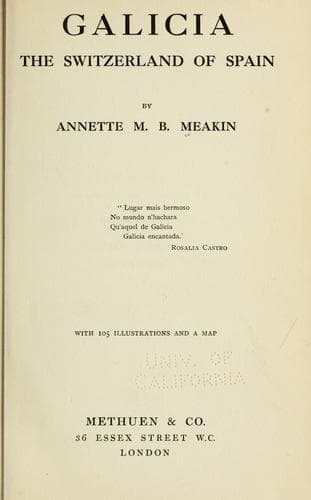
Galicia, the Switzerland of SpainMeakin, Annette M. B.
History
Galicia, the Switzerland of Spain
Meakin, Annette M. B.
Galicia (Spain : Region)
Our first drive was to the ramparts, to visit the tomb of England’s
hero, Sir John Moore. It was the 14th of January, a beautiful day, with
such hot and brilliant sunshine that the ladies were using parasols as
freely as if it were July. There had been a touch of frost in the night,
but as we drove through the public gardens, named after Admiral Mendez
Nuñez, with their waving palm trees and camellias full of handsome white
and red blossom, there was little to remind us of winter. The clear blue
sky was reflected in the sea, and the view of the rocky coast was very
fine as our road mounted behind the ramparts of the old town. A glaring
British Lion and Unicorn decorated the stone gateway leading to the
Gardens of San Carlos, which covered the top of the batteries. I wished
them away, for their appearance in such a spot bordered on the
aggressive, and jarred somewhat. Modesty becomes the great as well as
the brave. And, after all, it was the Spaniards who collected the money
for Moore’s monument.
We now alighted from our awning-covered vehicle and entered. There,
straight before us in the centre of the gardens, was the tomb we had
come to see, a marble sarcophagus, on which we read the following
inscription:--
“In memory of General Sir John Moore, who fell at the battle of
Elvina while covering the embarkation of the British troops, 16th
January 1809.”
The marble tomb stood on a square plot surrounded by a five-foot granite
wall with a granite vase at each corner filled with pink cyclamen; the
wall was surrounded by green grass, and the grass, in its turn, was
bordered by sunflowers.
In the grass at the four corners grew four palm trees. The rest of the
gardens consisted of winding paths between flower beds bordered with
box. The whole was enclosed between the rampart walls, which were
partially hidden by tall cacti covered with white blossom which had the
appearance of rosebuds.
When Borrow visited Coruña in 1836 he found the tomb of Sir John Moore
on the spot where he was buried by his soldiers “at dead of night,” on a
small battery of the old town, whose wall was washed by the waters of
the Bay. “It is a sweet spot,” he wrote, “and the prospect which opens
before it is extensive. The battery itself may be about eighty yards
square. In the centre of the battery stands the tomb of Moore, built by
the chivalrous French in commemoration of the fall of their heroic
antagonist. It is oblong and surrounded by a slab, and on either side
bears one of the simple and sublime epitaphs for which our rivals are
celebrated, and which stands in such powerful contrast with the bloated
and bombastic inscriptions which deform the walls of Westminster Abbey--
‘JOHN MOORE
LEADER OF THE ENGLISH ARMIES
SLAIN IN BATTLE
1809.’
Public-domain text, read in full here on John Shaqi.
Reviews
Reviews
No reviews yet
Be the first to share your thoughts on this work.
Elsewhere in the archive
Join the Discussion
Join the discussion
Sign in to leave a comment or review.
Sign InorCreate an account