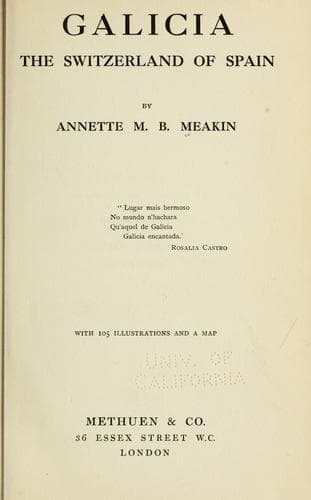
Galicia, the Switzerland of SpainMeakin, Annette M. B.
History
Galicia, the Switzerland of Spain
Meakin, Annette M. B.
Galicia (Spain : Region)
We visited an important ice factory, and watched the ice being made with
the help of liquid ammonia. By expansion of the liquid the necessary
cold is produced, the ammonia is pumped into the congealer and then
compressed and cooled by water, after which it again becomes liquid; and
so the process is repeated. Sea water is pumped into the factory at the
rate of fourteen tons an hour, by means of electricity. We saw the pipe
running along the beach; it was two hundred yards long. The water enters
the pipe at a depth of seven yards below the surface. As I have said, we
watched the ice being made. Fresh water filled great tin moulds; these
were then let down into a tank containing salt water rendered very cold
by means of pipes beneath, filled with the ammonia which had been
expanded from its liquid state into gas. The degree of cold which is
sufficient to freeze fresh water does not freeze salt water, so only the
water in the moulds was turned to ice. When the water in the moulds had
become ice, they were raised out of the salt water and tipped up so that
the ice blocks could slide out; each block weighed twenty kilos. That
the blocks might slip out easily, the moulds were dipped for an instant
into hot water. If the heat is too great, the ice sticks; but if it is
exactly the right temperature, the ice blocks slip out easily, like
puddings out of a pudding mould. The blocks of ice are kept in an
ice-house with pipes of ammonia running over the ceiling to keep the
temperature at freezing-point. The windows of the ice-house were made of
prisms, like bottles filled with air; they let the light of the sun
enter, but not its heat.
The sardines are caught in draughts.[190] They shun very cold water, and
are most plentiful on the Galician coast at periods when the Gulf Stream
flows nearest to the shore. Fishermen can tell when the sardines are
coming. As many as four hundred deal boxes (as large as petroleum cases)
are sent to Madrid every day from one factory during the sardine season.
The packing is almost all done by women. The women work with far more
energy than the men. This fact was pointed out to me by the manager of
the principal factory, and I saw for myself that it was correct. Strange
to say, it is only among the poorer classes that the women of Galicia
are remarkable for their energy.
“Our ladies are too fat, because life is too easy; they have not enough
work either for mind or body,” said a Spanish gentleman. “Even our men
are lazy,” he added. “In Spain a man waits to inherit his father’s
worldly goods, and as long as his father lives he remains the son, and
nothing else; he only gets responsibility and independence at his
father’s death. In England, on the contrary, a father gives his son
responsibility, educates him, and then expects him to make a position
for himself.”
Public-domain text, read in full here on John Shaqi.
Reviews
Reviews
No reviews yet
Be the first to share your thoughts on this work.
Elsewhere in the archive
Join the Discussion
Join the discussion
Sign in to leave a comment or review.
Sign InorCreate an account