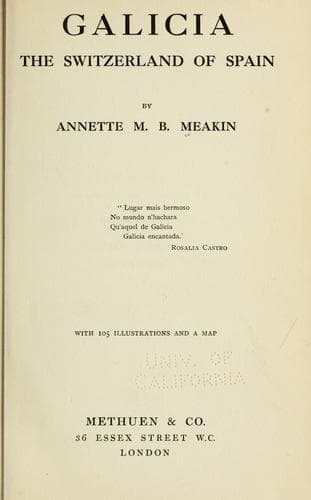
Galicia, the Switzerland of SpainMeakin, Annette M. B.
History
Galicia, the Switzerland of Spain
Meakin, Annette M. B.
Galicia (Spain : Region)
The house is in the hands of twenty Sisters, under a Mother Superior. In
my conversation with the lady boarder I learned that the poor there are
always discontented, and never cease to long for their liberty and for
the old life of begging at the street corners--where they had neither
shelter nor warm clothing nor food to eat. I really thought, after
seeing them huddled together in groups in the great, cheerful, but
_monotonous_ rooms, that while I had a spark of vitality and endurance
left in me I should feel as they did, and prefer the life of the street
with all its risks and privations to that deathly sameness. Monotony is
a slow and sure poison; it can undermine even the constitution of a
pauper. As for the poor of Coruña, they are chiefly fisher-folk, and
the coast being, as I have said, the most dangerous in Spain, cases of
drowning occur with painful frequency, so that the industry is a very
precarious one, and the number of the destitute is continually
increasing. Corpses of fishermen are constantly being washed ashore, and
there is nearly always a body lying in the mortuary to be identified.
There are only eleven tobacco factories in Spain. These are most of them
palatial; they all belong to the Government. The one at Coruña, like the
rest, is managed for the Government by a private Company, which is
allowed to appropriate 10 per cent. of the net profits. It was once a
very large factory, with six thousand women workers, mostly the wives,
widows, and daughters of fishermen, or men who have emigrated to South
America.[191] On the occasion of my visit, I found three thousand women
at work. Besides these, there were forty men employed in carrying the
heavy cases to the warehouse. The tobacco was supplied from various
places, chiefly from Kentucky, Mexico, Brazil, St. Domingo, Cuba, and
the Philippine Islands. In Ford’s day, an enormous amount of tobacco was
smuggled into Spain from Gibraltar, but that is not the case now.
Common cigars sell at about three a penny. Some of the workers have very
nimble fingers, and can prepare nine bundles, of forty cigars each, in a
day, while the slowest workers only manage about five bundles. They
begin work at 7 a.m., and continue till 8 p.m., bringing their dinner
with them, and leaving it in a neighbouring house, where it can be
warmed up if they wish. The women with whom it is left bring it in
baskets to the workers, who eat it where they sit, without leaving their
seats. In the factory at Seville they have a separate dining-room, but
none is provided at Coruña. Every fortnight the women are paid according
to the quality and quantity of the work they have done. We walked among
them as they worked, sixteen at a table, with coloured handkerchiefs
over their heads and tied tightly under the chin, with a three-cornered
shawl crossed over the breast.
Public-domain text, read in full here on John Shaqi.
Reviews
Reviews
No reviews yet
Be the first to share your thoughts on this work.
Elsewhere in the archive
Join the Discussion
Join the discussion
Sign in to leave a comment or review.
Sign InorCreate an account