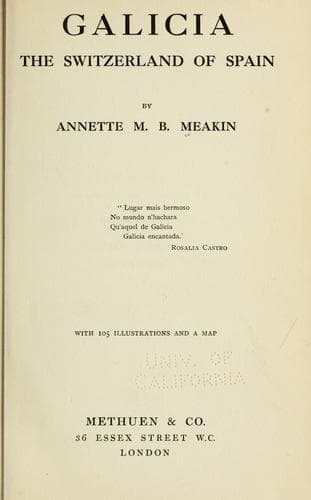
Galicia, the Switzerland of SpainMeakin, Annette M. B.
History
Galicia, the Switzerland of Spain
Meakin, Annette M. B.
Galicia (Spain : Region)
Like our Oxford, Coruña can boast of having afforded a refuge to the
National Assembly of her country, when it was forced to leave the
capital. In July 1706, when Madrid was crowded with English and German
soldiers who threatened to burn her to the ground, and the Court and the
Royal Family had established themselves at Burgos, a _Junta del Reino_
was called to discuss the calamitous state of the country, and that
Assembly was held in Coruña. Letters were sent on that occasion to
Santiago, Lugo, and Tuy, asking the citizens to supply forage for the
new battalions that were to be formed in Galicia, and it was mainly
through the bravery of Gallegan soldiers that the invaders were driven
out of the land.[192]
Coruña has one of the best harbours in Europe, and since the remotest
times this town has been considered one of the principal strongholds of
the Peninsula; its present fortifications are, it is true, very
antiquated, but there are projects on foot for once more converting it
into a stronghold of the first order. The town was fortified for the
first time in the reign of Henry III., but it was not till 1602 that the
work of strengthening it was seriously undertaken. The key to the port
is the fort of San Anton, on a small and rocky island which we passed at
the mouth of the harbour; but this fort, which was built in 1779, is now
little more than a ruin.
The most interesting church in Coruña is that of the _Colegiata de Santa
Maria del Campo_. It is a very small Gothic edifice with three naves. An
inscription on a column near the right pulpit bears the date Era 1340,
which is equivalent to the year 1302. The parish church of St. James
(Santiago) is also Gothic, but does not date farther back than the
sixteenth century. The largest church in the town is that of St. George;
the original one was rebuilt after Sir Francis Drake’s visit, but the
present one is the conventual church of the suppressed convent of St.
Augustine.
Coruña possesses a good Public Library, containing four thousand
volumes, with rooms devoted to Physical Science, Chemistry, and Natural
History. There is also a Meteorological Observatory, where candidates
for the post of pilot are examined.
CHAPTER XIV
EMIGRATION
An Agricultural Syndicate--The only flourishing industry--The
flower of Galicia’s youth--Monopolisation and subdivision of the
land--The lesser evil--The Argentine Republic--Free passages to
Chili and Valparaiso--Every peasant a proprietor--Socialism rare in
Galicia--Causes of Spanish indolence--Bad government--Railways
before roads--Nomadic instinct derived from Celtic
ancestors--Reputed stupidity of Gallegans--A story--Fields worked
by women--Usury--Need of wholesome literature--The potato
disease--Cattle breeding--Mules--The long rains encourage
idleness--Demand for factories--No wine-making industry--Failde
suggests a solution to the problem of emigration
Public-domain text, read in full here on John Shaqi.
Reviews
Reviews
No reviews yet
Be the first to share your thoughts on this work.
Elsewhere in the archive
Join the Discussion
Join the discussion
Sign in to leave a comment or review.
Sign InorCreate an account