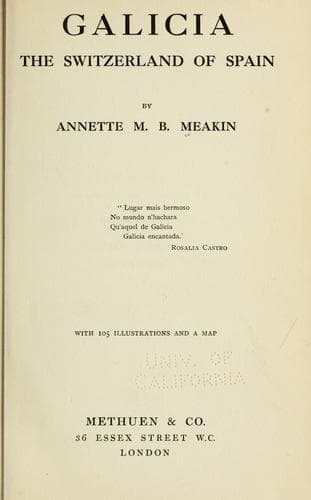
Galicia, the Switzerland of SpainMeakin, Annette M. B.
History
Galicia, the Switzerland of Spain
Meakin, Annette M. B.
Galicia (Spain : Region)
Galicia is a province where railways have preceded roads, and where
automobiles have preceded railways. There are towns in Galicia that are
decaying for want of roads by which they can carry on commerce with
their neighbours. All the water used in Coruña has to be carried by
women from the fountains, and the town waterworks are only now in course
of construction.
Aguiar speaks of the strong nomadic instinct of the ancient Celts as
being inherited by the Gallegan people--and certainly the Irish Celts
are addicted to emigration. As regards education--of the various
provinces in Spain, Galicia can boast of having the best educated lower
classes. Recently, when soldiers were being levied for the Spanish army,
it was found that ninety per cent. of the Gallegans could read, that
five per cent. could read but not write, and five could do neither;
whereas in Castille, fifty per cent. could read and write, and fifty
could do neither; and in Andalusia only ten per cent. could read and
write, while ninety could do neither.
Yet almost every writer on Galicia from Strabo onward speaks of the
stupidity of its inhabitants! Yes, the idea that the Gallegans are a
stupid people is quite classic. “The Romans,” says Señor Eladio Oviedo,
“thought them stupid because they would not submit, and were the
stubbornest of all the barbarians that Rome attempted to conquer. Even
Lope de Vega repeated this classic error--and we have it direct from the
classic writers of the sixteenth century.” Aguiar indignantly refutes
the belief, which was very widespread all over Spain in his day. He is
indignant with Morales for saying that one reason why the body of St.
James was lost for seven hundred years was the crass stupidity of the
Gallegans--calling it an atrocious insult, and remarking that the page
in question ought to be publicly burned.
Aguiar relates the following story which was current all over Spain in
1836, as an example of Gallegan dulness. “A sick man died, and the
doctor who had been attending him having pronounced him to be dead, he
was carried by his comrades in an open coffin to the cemetery. On the
way the corpse moved and showed unmistakable signs of life, then, to the
astonishment of the coffin bearers, sat up and cried, ‘Good heavens,
where on earth are you taking me?’
“‘To the cemetery,’ replied his friends.
“‘But if I am not dead?’ cried the poor fellow.
“‘You must be dead, because the doctor says so,’ was the reply, and on
went the procession.”
There appeared in the year 1902 a little book on the subject of Gallegan
emigration by Señor Valdes Failde, with a preface by Don Antonio
Cerviño, a Canon of Tuy, whose acquaintance I made during my stay in
that town. Both these gentlemen are confident that the emigration which
is going on is seriously debilitating the country, and if not checked
will be disastrous for the State. “Galicia,” says Cerviño, “is losing
every year the healthiest and most robust of her children.”
Public-domain text, read in full here on John Shaqi.
Reviews
Reviews
No reviews yet
Be the first to share your thoughts on this work.
Elsewhere in the archive
Join the Discussion
Join the discussion
Sign in to leave a comment or review.
Sign InorCreate an account