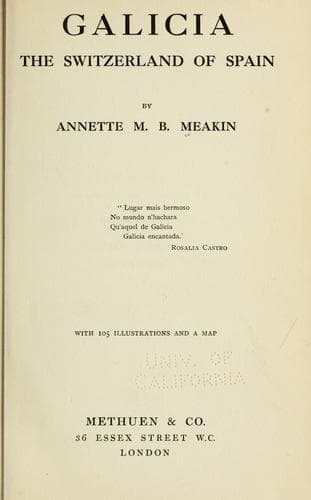
Galicia, the Switzerland of SpainMeakin, Annette M. B.
History
Galicia, the Switzerland of Spain
Meakin, Annette M. B.
Galicia (Spain : Region)
The name of Santiago has been given to one of the judicial departments
of the province of Coruña, which contains ninety-nine parishes, with a
total population of nearly eighty-two thousand souls. The town of
Santiago de Compostela has a population of about twenty-five thousand,
just about half that of Coruña; it is still the seat of an archbishopric
and a university town; it has never been without an archbishop since the
year 1120. In the Middle Ages Santiago was a walled city, but the walls
have almost entirely disappeared, and the houses now cover the hill and
even spread down its steep slopes into the surrounding valley. As we
have seen, the hill on which Santiago stands was covered with pine trees
until the discovery of the Apostle’s tomb in the ninth century, and the
cathedral, built upon the spot where the tomb was found, is practically
the centre and heart of the town, which, as far as its situation is
concerned, might well be called the Perugia of Spain. All round it are
beautiful valleys, covered, summer and winter alike, with verdant green;
and encircling the valleys are picturesque mountains, spurs of the
Pyrenees, between whose peaks other vistas open out, so that on clear
days the eye can travel as far as it will, over hill and dale, for many
a mile. Like Perugia, Santiago has beautiful views on every side, and
its air is mountain air. Here automobiles have preceded railways, just
as in Siberia railways have preceded roads. There is no railway between
Coruña and Santiago, and until 1906 the only means of transport were
hired carriages and a coach drawn by six horses. The coach does the
journey in seven hours, but now there is a regular service of motor cars
which take you there in less than four hours. The road, which passes
through the little town of Ordenes, is good, and the scenery fine; it is
practically uphill all the way, for Coruña is on the sea-level, while
Santiago is perched on a hill at a height of 500 feet, and surrounded by
mountains. In winter Santiago is many degrees colder than Coruña, while
in summer it is very much cooler. Although the days of pilgrimages to
the sepulchre of St. James are practically over, the hotels and
boarding-houses are always full of Spanish travellers during the summer
months.
Public-domain text, read in full here on John Shaqi.
Reviews
Reviews
No reviews yet
Be the first to share your thoughts on this work.
Elsewhere in the archive
Join the Discussion
Join the discussion
Sign in to leave a comment or review.
Sign InorCreate an account