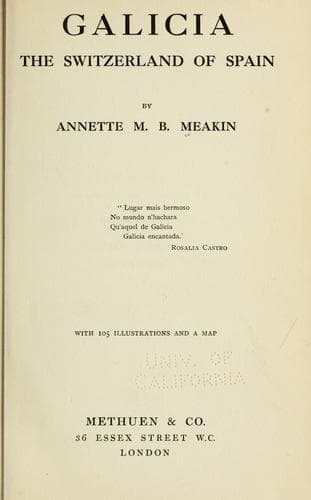
Galicia, the Switzerland of SpainMeakin, Annette M. B.
History
Galicia, the Switzerland of Spain
Meakin, Annette M. B.
Galicia (Spain : Region)
Bears are disappearing from the mountains both of Asturias and Galicia,
but they are still to be found in certain wild districts; the _urrus
pyraenaicus_ (Linn.) is still to be met with in Galicia, one was caught
a few miles from Santiago in the year 1848. The bear skins of Galicia
are, however, very inferior to those of the Alps.
Hares are plentiful in the lower slopes of the mountains, and in the
valleys. Great virtue was attributed to the skin of the hare in
antiquity. The Emperor Heliogabulus never sat, we are told, on any seat
that was not covered with one. The Gallegans use them for making hats;
the peasants catch them with traps made of large stones placed in front
of their holes.
Rabbits are also very plentiful,--in fact, there are, as usual, too
many. Spanish naturalists believe that the rabbit originated in Spain
and passed thence to the rest of Europe. They are not found in Sweden or
in any very cold countries. In Pontevedra and Orense rabbits do a great
deal of harm. The Gallegan word for them is _coello_, or _cocullo_.
Pliny says that rabbits did so much harm in the Balearic Islands in the
time of Augustus, that the inhabitants petitioned the Emperor to send
soldiers to assist them in driving them off, and thus prevent a famine.
Owls and bats are plentiful, they frequent the vaults of the churches.
The owls, _rhinolophus_, do not build nests, but make use of holes in
walls; they are called _lechuzas_ or sucklings, because they come out at
night and suck the oil out of the lamps. In the neighbourhood of
Santiago Cathedral they are especially troublesome. Moles are plentiful
in every part, and prove themselves great enemies to agriculture,
perhaps the greatest that the Gallegan peasants have to contend with:
the ancients made hats of their skin, but no use is made of them here.
The musk-rat, _musaraña_ (fetid shrew-mouse), _Ginera sorex_, is also
found in these parts; it has glands along the outside of its stomach,
under its fur, which give out a strong odour of musk. Seoane says these
are the smallest mammals known; some think them poisonous; there are
many fables about them. The Spanish word for musk is _almizcle_; it is
derived from the Arabic.
The common musk-rat, _sorex araneus_ (Linn.), abounds in all parts of
Galicia; and the peasants have an invincible horror of it; they declare
that it is poisonous, and that it bites their cattle and kills them,
though in reality it is much too timid. Cats kill them, but never eat
them on account of their smell. The water rat, _sorex fodum_, is
plentiful on the banks of rivers and lakes; its claws are not joined by
any membrane. Hedgehogs are also numerous; the peasants erroneously
believe that they climb apple and chestnut trees to get the fruit and
nuts. Pliny also had this notion. Hedgehogs swim well, however, if they
do not climb; snakes have a great horror of them. Pliny says that the
ancients used their skins and bristles for carding wool.
Public-domain text, read in full here on John Shaqi.
Reviews
Reviews
No reviews yet
Be the first to share your thoughts on this work.
Elsewhere in the archive
Join the Discussion
Join the discussion
Sign in to leave a comment or review.
Sign InorCreate an account