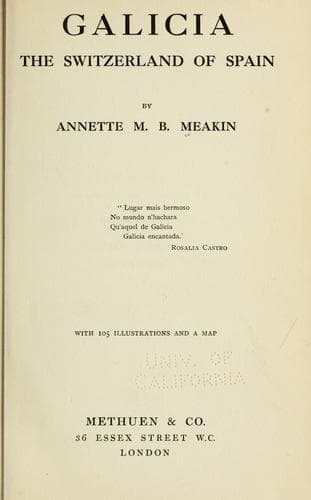
Galicia, the Switzerland of SpainMeakin, Annette M. B.
History
Galicia, the Switzerland of Spain
Meakin, Annette M. B.
Galicia (Spain : Region)
I have written at length in another chapter about the famous scallop
shells, _pecten veneris_, called _vieira_ in Galicia, and worn by
pilgrims returning from the sepulchre of St. James, and put up over the
doors of the inns at which they lodged in Santiago. Scallops are not too
sacred to be eaten even in Galicia, and, but for their strong fishy
smell, they would make a fair substitute for oysters.
Eels are very plentiful in all the Gallegan rivers, and, above all, in
the Miño; they are bred in the fresh water and go down to the sea when
full grown. The monks of Sobrado had an artificial lake, the eels of
which were greatly prized. Conger-eels are also abundant; the black ones
are the most esteemed. A tradition says there are some so large that a
man could not carry them on his shoulders, but would have to employ a
cart. Cornide says that the largest ever found in Galicia did not weigh
more than 100 lbs.
The common cod, _merluza_, which on the Mediterranean coast is called
_merlan_, is one of the most voracious and destructive of fishes, and,
as the Gallegans have discovered, it has a special predilection for
sardines, which it devours greedily. A certain amount of cod is dried on
this coast and taken into the interior; but the industry is anything but
brisk. Soles, _lenguado_, which the French call sea-partridges, _perdrix
de mer_, are very common, especially where the rias have a sandy bottom.
Salmon, _salmo salar_, are plentiful in the most northern rias, and
found throughout Galicia; they are best in hot weather, at which time
they are less prized in other parts. They were unknown to the Greeks,
according to Cornide, so have no Greek name. These fish enter the rivers
of Galicia from the month of January, lay their eggs in the sandy
places, and return to the sea until the next season, when they repeat
the journey. The Gallegans seldom catch more than can be disposed of
while fresh, but now and again there is an unusually large supply, and
then they are sold for next to nothing. Cornide tells of a priest who
salted a hundred and fifty salmon in one season.
A red mullet, Lat. _mullus barbatus_, is plentiful in the rias, but it
often tastes of the mud on which it feeds, and is not so choice as that
found in the rivers. Pliny and other classic writers thought that
people who ate too heartily of this fish injured their sight and nerves:
Gallegans call it _salmonete_, and are very fond of it. I have several
times seen it baked in pastry, like jam in an open tart. Trout,
_truchas_, are, as we have seen, remarkably plentiful and cheap in
spring; they abound in all the rivers, and would furnish plenty of sport
for British anglers.
CHAPTER XVIII
PADRON
Public-domain text, read in full here on John Shaqi.
Reviews
Reviews
No reviews yet
Be the first to share your thoughts on this work.
Elsewhere in the archive
Join the Discussion
Join the discussion
Sign in to leave a comment or review.
Sign InorCreate an account