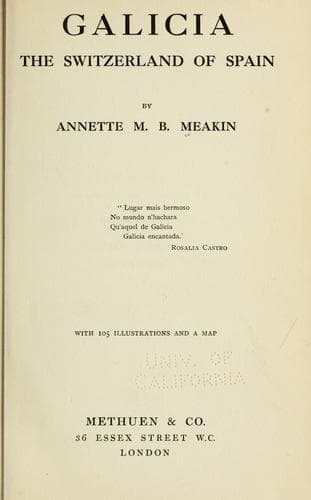
Galicia, the Switzerland of SpainMeakin, Annette M. B.
History
Galicia, the Switzerland of Spain
Meakin, Annette M. B.
Galicia (Spain : Region)
Pliny mentions this town under the name of Noela, and Florez heard that
there was a stone in the bridge over the Tambre which had the word
“Noela” inscribed upon it. According to popular tradition, the town was
founded by Noah, or by one of his daughters, and received its name from
that patriarch. However that may be, the arms of Noya, which may be seen
over the door of the little hospital, and which are printed at the head
of municipal letter paper, are Noah’s ark and a dove.[237] Both Pliny
and Pomponius Mela speak of all the coast of Galicia between the Duero
and Cape Finisterre as Celtic, and the dolmens with which the
neighbourhood of Noya abounds are another indication that this part of
Galicia was inhabited by Celts.
It was a glorious day, the 23rd of March, that we chose for our journey
from Santiago to Noya, and so hot that we were glad to leave off some of
our winter clothing. There is no railway to Noya, but a coach goes there
twice every day, and the journey takes a little over five hours. Our
coach started at two p.m.; the inside was like a box that would hold six
people, three on each side, with an upper storey covered with a double
or telescopic hood, which was filled with “second-class” passengers. The
Easter holidays began that day, so most of our fellow-passengers were
students from the University going home for Easter. They were sprightly
young fellows, with bright faces and strong limbs; it was a pleasure to
see them get out and walk up the hills. One of them picked a lovely
bunch of violets and handed them in to us at the coach window. From the
very start the scenery was beautiful; we were out among the giant hills
and fertile valleys in a few minutes, there being no ugly suburbs to
pass through. Noya lies, as we have seen, upon the sea level, but the
road thither from Santiago runs first down into a valley and then up,
up, up to the ridge of a very high hill, much higher than Santiago. Here
the air grew rare and bracing, and the scenery was like that between
Pitlochrie and Braemar. We passed innumerable _castros_ and _tumuli_,
and saw far off on the summit of a conical hill, which commanded the
surrounding valleys for many miles, the fine old castle of Altamira. The
family of Altamira is one of the oldest, and still one of the greatest
in Spain; but I hear that they are letting that fine old castle crumble
to ruin! Many a peasant with his bullock cart met us on the road, and we
always knew of a cart’s approach by the distant sound of musical
cartwheels, and once or twice, when three carts joined in the chorus,
the “singing” became very loud; I felt inclined to put my fingers in my
ears. A fellow-passenger remarked that the oxen needed some such sound
to cheer them on their way, and that the children always sing to their
oxen when leading them in the fields, because it makes them work better.
A little farther on, as we were passing close to a _castro_, another
Public-domain text, read in full here on John Shaqi.
Reviews
Reviews
No reviews yet
Be the first to share your thoughts on this work.
Elsewhere in the archive
Join the Discussion
Join the discussion
Sign in to leave a comment or review.
Sign InorCreate an account