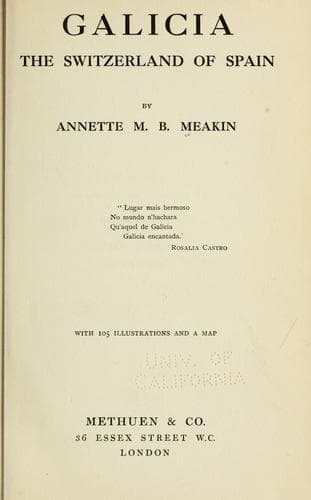
Galicia, the Switzerland of SpainMeakin, Annette M. B.
History
Galicia, the Switzerland of Spain
Meakin, Annette M. B.
Galicia (Spain : Region)
Morales, who visited Pontevedra in the reign of Philip II. (in 1572),
spoke of this church as _Santa Maria de los Pescadores_ (the fishermen’s
church), and said “they have spent more than twenty thousand ducats on
it, and intend to spend another twenty thousand, the sum still needed to
complete the work.” There are several pictures in the church, which,
though of little value as paintings, have still an archæological
interest, and there are some old chalices in the sacristy. In the
principal nave there is a graceful font, very shallow, with an
inscription round the brim and a sculptured pedestal.
On our way to Santa Maria la Grande, we had passed the ivy-covered ruins
of a beautiful Gothic abbey; the sky was visible through the lancet
windows of its graceful apses, and its crumbling walls seemed to speak
to us from another world. This was all that remained of the Conventual
Church of Santo Domingo.
I have heard this ruin spoken of by archæologists as the sole specimen
of purely Gothic architecture in the whole of Galicia; every other
church in the province seems to have borrowed something from the style
of the Cathedral of Santiago de Compostela. In 1880, Fita urged that the
ruins of Santa Domingo at Pontevedra should be carefully guarded, and
preserved as a national monument, but to-day the practical citizens of
Pontevedra are complaining of the space taken up by its walls, and
suggesting that it be cleared away to make room for some useful modern
building!
In a history of the Order of San Domingo, published in 1613,[254] it is
stated that there is no document in existence which gives the date of
the foundation of Santo Domingo of Pontevedra, but that the site for it
was purchased in Era 1321 (1283 A.D.) from a lady, Donna Sancha Roca
Helda, and it is certain that the edifice was standing in the beginning
of the fourteenth century. All that remains of it to-day is a little bit
of the transept and its five polygonal apses--one large one with two
small ones on either side; all five have fan vaulting and double lancet
windows. The ornamentation of the columns is iconographic: on one of the
capitals is sculptured a fight between warriors and a dog; on another,
monster birds with long twisted necks attacking one another with their
beaks. The inner walls show traces of having been once covered with
frescoes representing the Resurrection and the Life of Santo Domingo, of
which some still remain. “It is the number of the apses,” writes
Villa-Amil, “which constitutes the singularity of this church, for it is
the only one of all the conventual churches built in Galicia during the
Middle Ages which has that number, all the others (and here he mentions
ten) have only three. Otherwise there is nothing remarkable about it.”
The door which opened between the church and the sacristy is still
there; it is Gothic, with an archivolt decorated with fluted mouldings,
leaves, and twisted fillets; the statues which adorned it are gone. In
Public-domain text, read in full here on John Shaqi.
Reviews
Reviews
No reviews yet
Be the first to share your thoughts on this work.
Elsewhere in the archive
Join the Discussion
Join the discussion
Sign in to leave a comment or review.
Sign InorCreate an account