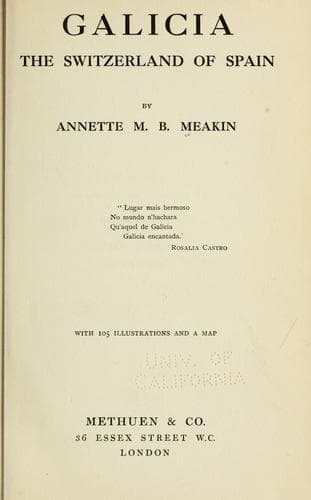
Galicia, the Switzerland of SpainMeakin, Annette M. B.
History
Galicia, the Switzerland of Spain
Meakin, Annette M. B.
Galicia (Spain : Region)
The founding of this most unique and fascinating Museum in 1896 was due
to the suggestion and energy of Señor Casto Sampedro, who has not only
devoted endless time to its arrangement, but has published with the
minutest care, in the local _Archæological Journal_, all the
inscriptions it contains as well as those from the local churches. Señor
Sampedro is a lawyer by profession, but his office is a veritable
curiosity-shop, filled with antiques of every class and description: he
is also an epigraphist, highly skilled in deciphering ancient documents.
When a manuscript gives him any trouble, he pins it on his office wall,
and looks at it at intervals during his work, sometimes for days
together, before the correct meaning occurs to him. Señor Castro was
also the founder of the Pontevedra Archæological Society.
We next visited the church of the Franciscan monastery. This edifice is
built in the shape of a Latin cross, with one very wide nave and a wide
transept; at the head of the nave are three Gothic apses, a large one
the width of the nave, and a smaller one on either side. The apses have
recently been restored, and the lancet windows which had been bricked up
are now filled with coloured glass from the manufactory at Leon. The
transept was begun in the fifteenth century, but the rest of the church,
with the exception of the chapels, dates from the middle of the
thirteenth. The apses have fan vaults, and are of the first period of
Gothic art, very similar to those of Santo Domingo. The side chapels are
filled with the sumptuous tombs of wealthy families of the vicinity. The
table of the chief altar is a great stone slab, seventeen feet long and
three wide; it is thought to date from the foundation of the edifice. On
one of the lateral altars I noted a black-faced statue of St. Benedict
of Palermo. Two pairs of sarcophagi at the foot of the steps leading to
the chief altar had the recumbent effigies of two interesting couples;
their length is about seven feet. One on the right is thought to be a
famous admiral of the fourteenth century, the legendary Chariño. The
feet of all these effigies are crossed, their heads rest upon stone
pillows, while the top of each sarcophagus represents a couch. The
inscription on the tomb thought to be that of Chariño has been the
subject of considerable discussion in books and pamphlets. Payo Gomez
Chariño was the admiral who, at the head of a fleet composed of
twenty-seven ships from Pontevedra and thirteen from Noya, broke and
burned the famous bridge over the Guadalquivir
[Illustration: PART OF THE MUSEUM OF ARCHÆOLOGY AT PONTEVEDRA]
[Illustration: TOMB OF AN AMBASSADOR TO TAMERLANE IN THE MUSEUM OF SANTO
DOMINGO]
near Seville, _Puente de Triana_, which, being the key to the Moorish
dominion of that part of the country, enabled Ferdinand III., to take
the city.
Public-domain text, read in full here on John Shaqi.
Reviews
Reviews
No reviews yet
Be the first to share your thoughts on this work.
Elsewhere in the archive
Join the Discussion
Join the discussion
Sign in to leave a comment or review.
Sign InorCreate an account