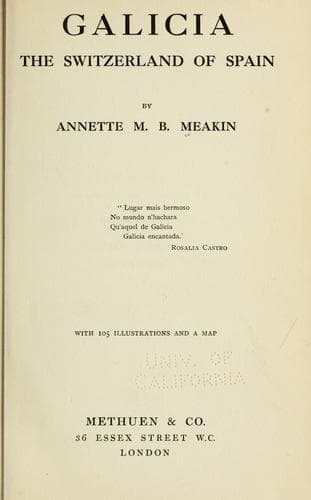
Galicia, the Switzerland of SpainMeakin, Annette M. B.
History
Galicia, the Switzerland of Spain
Meakin, Annette M. B.
Galicia (Spain : Region)
The convent of Santa Clara is surrounded by lofty and forbidding walls;
part of it is very old and part quite modern. Tradition says that the
original building was a centre for the Knights Templars, whose duty it
was to protect pilgrims and travellers on their journeys through the
wilder parts of the country: it is said that this accounts for the fact
that there is no escutcheon of the Order of Santa Clara upon the walls.
The apse of the conventual church is Gothic, and resembles, with its
lancet windows, those of Santo Domingo and San Francisco: the nuns are
not allowed to leave their convent on any pretext whatsoever--they are
cloistered for life; they do not even enter the body of their church,
but worship in a gallery behind a wooden trellis, like the Jewesses in
the synagogues of Bokhara.
Our next drive was across the bridge to the village of Combarro, and
then on to the monastery of San Juan de Poyo Grande, to hear the monks
sing the _Salve Regina_ at their Saturday afternoon Mass. As we were
just reaching the bridge, we got out of our carriage to look at the
little house in which Pedro Sarmiento is said to have been born. Pedro
Sarmiento de Gamboa was a celebrated navigator of the sixteenth century.
Sir Clements Markham tells us that Sarmiento’s writings on the Straits
of Magellan are admirable work, and well known to English naval
surveyors.[256] It seems that Sarmiento left Pontevedra at the age of
eighteen, and devoted seven years of his life to studying the Incas. The
Inquisition found him guilty of possessing mysterious and magic rings,
and although his confessor had authorised his collecting them, he was
condemned to say Mass, on his knees and nearly naked, in the Cathedral
of Lima. While this sentence was being carried out, he was shut up in
the convent of Santo Domingo without a single book, fasting on
Wednesdays and Fridays, and reciting seven psalms a day. At length his
case was brought before the Pope, who somewhat softened the severity of
his punishment. He eventually returned to Spain, equipped a large fleet
and sailed forth, to be caught by three English ships and tortured to
confess that he carried precious metal. The English took him to
Plymouth; he travelled thence to Windsor, where he was kindly treated
by Queen Elizabeth, till his enemies got up some scandals about him,
whereupon Elizabeth sent him on a diplomatic mission to Flanders and
afterwards on another to Spain. He was taken prisoner, while asleep at
Burgos, by Viscount de Bearny, and put in prison; thence he was ransomed
by the king for six thousand _escudos_, and four horses. Such was the
early history of the eminent navigator. He wrote many books, including a
_Treatise on Navigation_, _Information concerning the Stars_, and a
_Treatise on Fortification_.
Public-domain text, read in full here on John Shaqi.
Reviews
Reviews
No reviews yet
Be the first to share your thoughts on this work.
Elsewhere in the archive
Join the Discussion
Join the discussion
Sign in to leave a comment or review.
Sign InorCreate an account