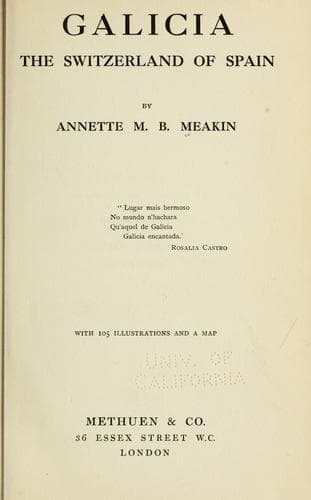
Galicia, the Switzerland of SpainMeakin, Annette M. B.
History
Galicia, the Switzerland of Spain
Meakin, Annette M. B.
Galicia (Spain : Region)
We ascended to the castellated parapet at the top of the keep to enjoy
the exquisite panorama of the wide village-dotted valley and the
surrounding peaks; there was the river Verdugo, and yonder, the
waterfall which supplies Vigo with electric light; in the distance we
could see the village of Puente Caldelas; all the pine woods and the
meadows in the vicinity of the castle are part of the Sotomayor estate.
Opposite the Castle Mos on a cone-shaped hill, a little loftier, if
anything, we could see ruined walls and a chapel. This was the peak
called la Peneda, and the chapel of _la Virgen de la Peneda_; the walls
are a remnant of fortifications placed there by a fighting Archbishop of
Santiago to whom all the valley was subject, that he might keep an eye
on the movements of the unruly Sotomayors.
The turret is filled now with small bedrooms for visitors, and huge
wardrobes stand in the passages, while in every bedroom there is a
commodious zinc bath. The reception-room, the ceiling of which is
handsomely carved, is draped with fine old tapestries, but those on the
walls of the dining-room are modern. Good old-fashioned stone chimneys
and wide hearths give the whole place an air of comfort; there is a
billiard-room with French windows opening into a stone balcony on two
sides of it, and from here we see three old cannon still perched upon
the outer walls; they are ornaments now, and covered with verdigris, but
there was a day when they had their use. In the billiard-room we found a
little book describing the castle, written by a niece of the present
marquis, la Marquesa de Ayerbe;[258] she has published several other
works. The marquesa began her book with a quotation from Taine,[259]
about the kings and knights of the Middle Ages being one and all
warriors by profession, and who, in order to be always ready, had their
horses standing in their bedrooms while they slept. Then came a verse by
Molina, in which he enumerates the great families of Galicia, including
that of Sotomayor. “The reason that Sotomayor arrives so far on in the
list is,” explains the marquesa, “because Molina, to be quite impartial,
took the families alphabetically--there is no question of precedence.”
The authoress tells us she was herself born, baptized, and married in
the castle, so that she has spent nearly every summer of her life there,
and that she is a true native of beautiful Galicia, which she
passionately loves. She reminds her readers of Taine’s remark that in
the days of the Moors in Spain all the eminent medical men, surgeons,
artists, and men of brains and talent, generally were either Moors or
Jews, and that they exercised a beneficial influence upon the country by
importing civilisation from the East. She also gives an interesting
quotation from the will of a Sotomayor, which is still in existence and
bears the date 1468, and another from one dated 1472; she states further
that the fort on a neighbouring peak is called _Castrican_ or
Public-domain text, read in full here on John Shaqi.
Reviews
Reviews
No reviews yet
Be the first to share your thoughts on this work.
Elsewhere in the archive
Join the Discussion
Join the discussion
Sign in to leave a comment or review.
Sign InorCreate an account