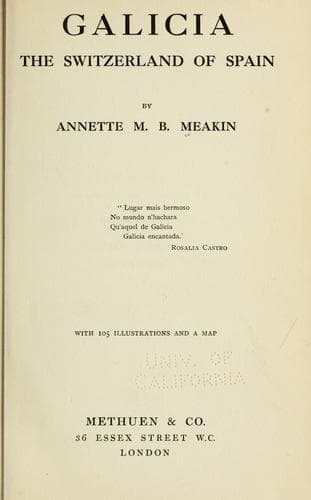
Galicia, the Switzerland of SpainMeakin, Annette M. B.
History
Galicia, the Switzerland of Spain
Meakin, Annette M. B.
Galicia (Spain : Region)
The prettiest spot through which we passed on our railway journey from
Pontevedra to Vigo was Redondela, whose picturesque houses scattered
among the green hills and fringing the Ria de Vigo, with a tiny harbour
all to themselves, were a delight to the eye as we looked down upon them
from the train windows. Macaulay mentions Redondela, and alludes to the
fact that it was sacked by the English in 1715. Southey was charmed with
it when he passed through on his way from Coruña to Lisbon, and he took
the trouble to translate into English verse a long legend about one of
its ancient towers,[264] telling how a lover jumps into the sea in his
despairing frenzy. It was Southey, too, who wrote--
“Spain! still my mind delights to picture forth
Thy scenes that I shall see no more, for there
Most pleasant were my wanderings. Memory’s eye
Still loves to trace the gentle Miño’s course,
And catch its winding waters gleaming bright
Amid the broken distance.
... Galicia’s giant rocks
And mountains clustered with the fruitful pines,
Whose heads, dark foliaged when all else was dim,
Rose o’er the distant eminence distinct,
Cresting the evening sky.”
Redondela, once an important town, is now little more than a collection
of scattered villages, whose inhabitants are chiefly engaged in oyster
fishing. At high tide the waters of the Ria de Vigo come right into the
town by way of a little river that passes through it under a pretty
bridge, which separates Redondela from its neighbour, Villavieja. Out in
the blue waters of the Ria we could see the famous little Hospital of
San Simon floating like a shell upon the surface.
Our train hugged the shore of the Ria, winding and curving with the
water’s edge till we came into the station of Vigo. Vigo is the most
modern town in Galicia; it owes its rapid development to its
geographical situation and to its bay and harbour, famed for being among
the finest in the world. Some forty years ago Vigo was a tiny village,
known as Vigo de Cangas. Cangas, situated on the opposite bank of the
Ria, is still nothing but a village with a few scattered houses, and it
seems incredible that Vigo was, so short a time ago, one of its
dependent hamlets. Vigo is built upon the sloping side of a hill, from
the top of which mountains may be seen on every side except where the
Ria bounds it on the west. Between the various mountain peaks may be
seen fertile valleys of all shapes and sizes, and separated from one
another by mountain ridges covered with oaks and pines.
Public-domain text, read in full here on John Shaqi.
Reviews
Reviews
No reviews yet
Be the first to share your thoughts on this work.
Elsewhere in the archive
Join the Discussion
Join the discussion
Sign in to leave a comment or review.
Sign InorCreate an account