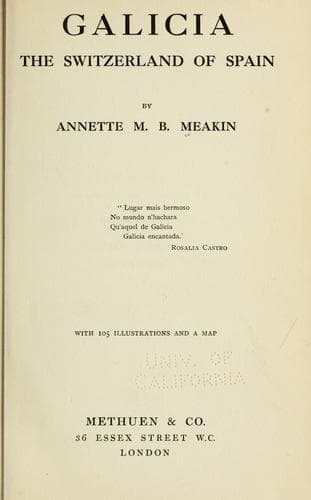
Galicia, the Switzerland of SpainMeakin, Annette M. B.
History
Galicia, the Switzerland of Spain
Meakin, Annette M. B.
Galicia (Spain : Region)
Another church worth examination is that of Santo Domingo. This building
was consecrated by Bishop Sarmiento in 1534,[268] but the Gothic
vaulting was only completed in 1730. A large part of the expense of its
completion was borne by the Sotomayor family, two of whom became bishops
of Tuy. The church is in the form of a Latin cross with very short arms,
and only one wide nave terminating with a hectagonal apse and two small
circular chapels to right and left. The Pointed Gothic arches of the
nave rest upon Græco-Roman pillars supported by exterior buttresses. The
central arch leading to the apse is also Pointed Gothic, and rests upon
Gothic pillars. The vaulting of the transept is cylindrical, but the
rest of the vaulting is Gothic.[269] The Gothic apse, which reminds us
strongly of that of Santo Domingo at Pontevedra, was formerly lighted by
three long and narrow lancet windows, and the smaller apses had each two
such windows, but the bad taste of the eighteenth century led to their
being all bricked in, in order that a hideous reredos might be placed
behind the altar. There are two entrances to this church, the chief one
at the end of the nave, and another, called the Door of the Rosary, at
the end of the south arm of the transept. This last is pure Romanesque,
and possibly the oldest part of the edifice; it has an archivolt
composed of two pointed arches which rest upon two pairs of shafts. The
capitals are curiously sculptured: on one I could distinguish faces of
angels and long-necked swans, on another was a monkey with a long tail
twisted round some small object. On the tympanum, within a border of
horseshoe arches, there is a very old group representing the Adoration
of the Magi, the figures of which have been sadly mutilated. Enclosing
the tympanum is an arch decorated with various images of a symbolic
nature. The Eternal Father is represented by a hand stretched out from
clouds in the act of benediction.
We now come to the Cathedral, which is the principal object of interest
in Tuy. King Ferdinand of Leon conquered Tuy and took it from Alfonso of
Portugal in 1170, and as he made a handsome donation in 1180 to its
bishop for the building of a Cathedral dedicated to the Virgin Mary, it
is thought that this was the date at which the foundations were
laid.[270] The Cathedral was consecrated in 1124, and at the same time
opened for public worship. The original plan of the building was in the
form of a Latin cross with very short arms, and with three naves in the
transept as well as in the body of the church.
Public-domain text, read in full here on John Shaqi.
Reviews
Reviews
No reviews yet
Be the first to share your thoughts on this work.
Elsewhere in the archive
Join the Discussion
Join the discussion
Sign in to leave a comment or review.
Sign InorCreate an account