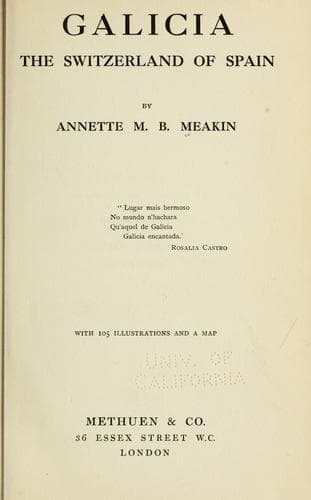
Galicia, the Switzerland of SpainMeakin, Annette M. B.
History
Galicia, the Switzerland of Spain
Meakin, Annette M. B.
Galicia (Spain : Region)
We next visited the Orense Museum. Here we found a stone bearing an
inscription relating to the Burgas, or Hot Springs, which had once been
erected near them by the Romans; the inscription was in honour of the
nymphs who were supposed to haunt the springs. Here also we found
several interesting stone sarcophagi; one was that of a converted Jew of
Monforte who spent a great deal of money on the churches; his name was
Gaibor, and he flourished in the eighteenth century. Here, too, were
specimens of good Roman mosaic, taken from the Roman baths in the
neighbourhood; some Byzantine capitals; a sarcophagus bearing an
inscription in the Gallegan dialect, from the fourteenth century; a
sarcophagus of the fifth century without a cover; a bronze cross of the
fifth century; some Roman pens; some Roman amphoras; bronze hatchets
found in the bed of the Miño; and a number of arrow-heads, some of green
serpentine, others of stone. Among the documents were some Papal Bulls
and other parchments in a glass case. One of the things that interested
me most was a musical instrument of mediæval structure; it had a handle
like a barrel organ, but its strings and screws were like those of a
violin. I am told that this strange kind of instrument is still in use
among the blind musicians of Galicia; and there are two of them
represented in the Orense _Pórtico de Gloria_, two of the
four-and-twenty elders are playing them by turning the handle. In this
museum we also found a good specimen of the Gallegan bagpipe, or
_gaita_. It was here that Señor Macìas showed me a recently completed
plan of the old Roman road that passed through Orense from Braga to
Astorga, at which he and several other archæologists had been working
for some time. The walls of the museum are hung with old paintings, some
of them being portraits of the family of San Rosendo, brought from the
monastery of Celanova. But perhaps the most treasured object of all is
the stone with the Roman inscription which Señor Macìas and his friends
had such difficulty in removing from the site of the ancient _Civitas
Limicorum_.
Public-domain text, read in full here on John Shaqi.
Reviews
Reviews
No reviews yet
Be the first to share your thoughts on this work.
Elsewhere in the archive
Join the Discussion
Join the discussion
Sign in to leave a comment or review.
Sign InorCreate an account