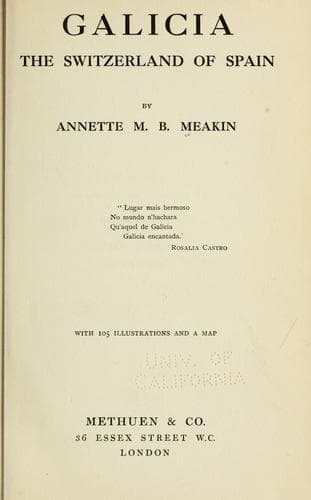
Galicia, the Switzerland of SpainMeakin, Annette M. B.
History
Galicia, the Switzerland of Spain
Meakin, Annette M. B.
Galicia (Spain : Region)
The word _plateresco_, or plateresque (from plata silver), is derived
from the idea of silver filigree. The stone lacework of the Burgos
cathedral, to take a well-known example, is _plateresque_. The word
_churrigueresque_ is derived from the name of José Churriguera, though
Churriguera was not the first to introduce it, Pedro Ribera and Narciso
Tomé having been before him. Between the middle of the seventeenth
century and the middle of the eighteenth, the Churrigueresque style of
decoration was looked upon as the most perfect in creation.
“Along with all the contradiction, all the praise and the censure with
which this style of architectural decoration has been heaped,” says
Lamperez, “we must consider what are the eternal and unchanging laws of
architecture; we must remember that this art is not one of initiation,
but of interpretation. Its form must be judged in relation to the end it
has in view; it has both active and passive elements. It may seem hard,
but we are compelled to pronounce the verdict that the so-called
_churrigueresco_ style does not meet these requirements of true
architecture. It may do honour to the man who executed it, but it does
not bring honour to the architect who designed it.”
The period during which the Churrigueresque style predominated was that
which began with the year 1669 and closed about the middle of the
eighteenth century. José Churriguera was born and educated at Salamanca.
He made his name by work on the tomb of Queen Maria of Savoy, who died
in 1489. Pedro Ribera exaggerated the defects of his master in the
fountain of Anton Martin; so also did Narciso Tomé, who let the light
through the roof of Toledo Cathedral by inserting an architectural
filigree of Churrigueresque work. “The idea,” remarks Lamperez, “was
bold in the extreme, and the conception grandiose; but--it produces
optical illusions, a panoramic, not an architectural effect.” No art
should ever be permitted to overstep its limits, and the architecture of
Spain commits this crime in its most excellent examples of the
Churrigueresque style. The examples of this style in Spain are very
numerous, but of them all the most beautiful and sumptuous, the most
truly magnificent and monumental, example in the whole of the Peninsula
may be seen in the façade of the Cathedral of Santiago in Galicia, which
was the work of Casas y Novea in 1737.
CHAPTER VIII
THE CATHEDRAL OF SANTIAGO
Public-domain text, read in full here on John Shaqi.
Reviews
Reviews
No reviews yet
Be the first to share your thoughts on this work.
Elsewhere in the archive
Join the Discussion
Join the discussion
Sign in to leave a comment or review.
Sign InorCreate an account