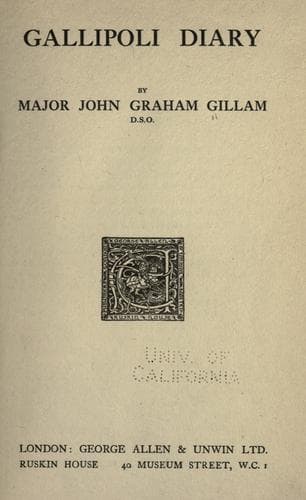
World War, 1914-1918 -- Campaigns -- Turkey -- Gallipoli Peninsula
We rode to the gully, and then down on to the beach; there a priest
was preparing an altar on biscuit-boxes, and about four hundred troops
were waiting to take Holy Communion. We rode up the bed of the gully,
and it was the first time that I had been right up. The Engineers had
made a good road up, winding in and out between high, irregular cliffs,
covered with gorse, and passing little gullies running out of the main
one, to right and left. All up, for about a mile and a half, the sides
are honeycombed with dugouts for troops to rest after a spell in the
trenches, for Battery H.Q., and signal posts, etc. We passed the H.Q.
of the 86th Brigade, the latter being dug-in in a charming spot a mile
up from the beach. Thompson, my late Staff Captain, was seated on a
terrace high up the cliff, shaving, and shouted “Good-morning” to me.
Arriving at the head of the gully, we dismount and hand over horses to
a groom, with instructions to him to take them across country to Pink
Farm. We meet Harding, the Q.M. of the Royal Fusiliers.
We climb up the right side of the gully—a most beautiful spot, which
would delight artists—and enter into a trench, over which bullets
whiz, and now and again shrapnel. Passing along the trench for some
way, we turn to the left, and go for quite a hundred yards along the
communication trench, leading into a maze of trenches, but we are
enabled to find our way by directing sign-boards, such as “To Reserve
Trenches,” “To Support Trenches,” “To Fire Trench,” and names of units
marked on as well.
We at last find ourselves in the Reserve, and have a chat with the
Essex. Then we wend our way and pass along an uninhabited trench, an
evidently disused communication trench, and come on what is literally
the emblem of death grinning at us. We see a grinning skull, with
almost all the flesh rotted off it, a bundle of rags, a hand, and two
lower parts of legs with boots and puttees intact. Such a sight in
earlier life would have filled me with horror. But I look upon such
sights now as one would look upon a ruined house.
We come to a dugout in the support trenches, and are asked to wait, as
two men have just been hit by shrapnel. Two R.H.A. men tell us that at
the end of the next communication trench there is a Naval 12-pounder
gun that had opened fire that morning on what was thought to be a
poisonous-gas factory in a nullah in the Turkish lines, and that a
Turkish battery had found our gun out and was shelling it. The two men
who happened to be here had been hit. Shelling seems to have ceased,
and one R.H.A. man said to the other, “Come on, Bill; if we are going
to get ’it, we are going to get ’it!” This sounded good philosophy,
and so we followed them. One of them shouldered a sack of food, and
the other two jars of rum. Round the corner we passed the two wounded
men—one wounded in the arm and the other badly in the shoulder; but
both seemed quite cheerful about it.
Public-domain text, read in full here on John Shaqi.
Reviews
Reviews
No reviews yet
Be the first to share your thoughts on this work.
Elsewhere in the archive
Join the Discussion
Join the discussion
Sign in to leave a comment or review.
Sign InorCreate an account