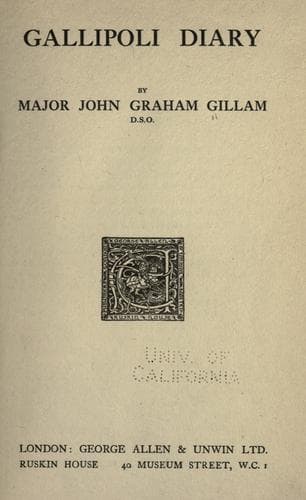
World War, 1914-1918 -- Campaigns -- Turkey -- Gallipoli Peninsula
Everywhere everybody is hard at work making dugouts. In the line our
infantry are feverishly making a line of defence, digging night and day
without cessation. “A” Beach gets shelled, but no shells reach our end
of the promontory. Our battleships’ guns roar out continually all day,
as if in sullen anger at the recent failure—at what I am afraid will
be our last effort. My Brigade has moved over from Chocolate Hill, and
is in the line on the low part of the slope of the high hills which
form the left flank, next to the sea, of our position, and Brigade H.Q.
is dug in behind a hillock in a gully which has been called Lone Tree
Gully.
_August 27th._
A violent gale blowing to-day. Carver, Petro, and Phillips are now here
as transport officers.
Work on the beaches now goes on feverishly, night and day. Each day a
new sand-bagged dugout appears. Additions are made to the piers. Two
off West Beach are complete. One further up, towards the end of the
promontory, is being built rapidly and skilfully by a bridging party of
regular Australian Army Engineers. I am told by their warrant officer
that there is a regular Australian Army, but that it is being jealously
guarded in Australia, and that really it is only a framework of an
army. The bridging section, however, at Suvla is part of this. The
fighting army of Australia and New Zealand is voluntary since the war,
yet is superior in fighting qualities to the Prussian Guard.
Further up, towards the end of the promontory, two small beaches or
coves are rapidly being turned into fitting order to receive the steady
requirements of food, ammunition, S.A.A. stores, ordnance, etc., and
piers there are rapidly being thrown out. At night, long convoys of
A.T. carts and pack-mules form up loaded with rations, A.S.C. and
Ordnance stores and ammunition, and proceed along the promontory
towards the mainland. On arrival there they branch off in various
directions to their respective destinations, just behind the line.
Early on their journey they encounter the song of bullets flying from
the Turkish line continually all night. I think that the Turks in the
front line must be given so many rounds of ammunition and told to loose
off in the air in our direction, not aiming at anybody, but firing
blindly in the hope of a victim. Now and again a bullet does find a
victim, but on going up regularly each night one gets so accustomed
to the sound of their flight, that one walks on, taking no notice;
although, if by any chance a rifle is pointing directly your way, even
at a thousand yards’ range, it sounds as if it is fired close to your
head, and almost simultaneously, “whizz-ping,” goes past you very near,
and then unconsciously you duck.
The drivers on the A.T. carts, however, worry about the bullets less
than anybody, remaining sitting on their carts and chanting away
contentedly.
Public-domain text, read in full here on John Shaqi.
Reviews
Reviews
No reviews yet
Be the first to share your thoughts on this work.
Elsewhere in the archive
Join the Discussion
Join the discussion
Sign in to leave a comment or review.
Sign InorCreate an account