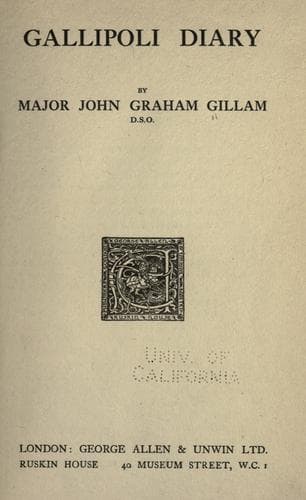
World War, 1914-1918 -- Campaigns -- Turkey -- Gallipoli Peninsula
Gee, forty-five years of age, and who at the best of times could not
be called robust-looking, stuck this storm through at his post in the
trenches, which are situated on the lowest ground—trenches which in
consequence suffered the worst of all—until he was relieved.
He told me after that on coming back on relief he came to a small
nullah, and that he was so weak and finished that he actually cried
like a child before he could summon up the will-power to get across
that little brook, which at ordinary times he would have cleared at a
leap.
_Later._
The evacuation of Suvla, which was decided on before the storm and
then cancelled, I believe has now been finally decided on. Parties are
now hard at work at night improving the second line, which stretches
behind our first line on the same latitude as our C.R.E. dump, across
the Gibraltar road and over to Hill 10. A third line is being dug
just a short way in on the mainland from “W” Beach, and over the hill
of the promontory a fourth line also. Our dugout is now being rapidly
repaired, and the dugouts behind on the higher ground, one story
higher, are now finished. All the dugouts are built together as a
whole, really forming a picturesque house. On the ground floor, up a
short path bordered by little gorse-bushes and a rockery, one enters
our messroom, furnished with a table, arm-chairs, and a stove made from
an oil-drum. Two smaller rooms lead out from the left, and two from the
right. One is the clerk’s office, in which he sleeps, and the other
three are each occupied by Horne, Elphinstone, and myself.
Next to our dugouts, on the same level, are the dugouts of the Q.M.’s
of a few regiments, which are built on the same scale as ours, but
separated by a flight of about a dozen steps running up in a bend to a
row of smaller dugouts, which house the N.C.O.’s of our Supply Section,
a few quartermaster-sergeants, regimental N.C.O.’s, and the two Brigade
postal staffs. Opposite, in the gully, as the trenches that we had
made are now damaged beyond repair by the recent storm, the remainder
of the men live in shelters made from sailcovers and tarpaulins,
with shrapnel-proof roofs, built in places where boulders and mounds
of earth protect them from high explosive shells. Behind us is an
Egyptian encampment, situated in full view of the Turks among rocks
and boulders. But as they sleep most of the day, working only at night
digging on the beaches, they cause very little movement to be seen by
the enemy, and in consequence have been very little shelled. If a shell
does come near them, however, they make no bones about running as far
away as possible, chattering like a lot of chickens.
All day cases of frozen men, now happily diminishing in number,
are being shipped off. It was the most terrible storm I have ever
witnessed.
DECEMBER
_December 1st._
Public-domain text, read in full here on John Shaqi.
Reviews
Reviews
No reviews yet
Be the first to share your thoughts on this work.
Elsewhere in the archive
Join the Discussion
Join the discussion
Sign in to leave a comment or review.
Sign InorCreate an account