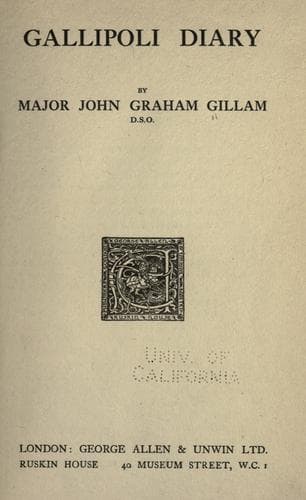
World War, 1914-1918 -- Campaigns -- Turkey -- Gallipoli Peninsula
The Turks cannot
see the gully, but know that men are collecting there by the procession
of them streaming over the skyline of the promontory. As we walk on
towards the 88th Field Ambulance, about four more shells scream over
the hill to the gully, which by this time is deserted; and as we sit in
the ambulance waiting for a friend who is walking up with us to Brigade
H.Q., the Turks increase their range and send a few nice fat, juicy
ones over to the beaches.
Leaving the ambulance, we walk down the slope to the Gibraltar road and
meet Grant, our G.S.O.3, who has just come back from the trenches. He
is in shorts, caked with mud up to his knees and thickly bespattered
over the rest of his body, which gives evidence of the present state
of the trenches, even though it is over ten days since the storm. He
tells us that in fifteen minutes we are going to open fire with all
guns on to the unfortunate Pimple. We continue our way up the Gibraltar
road, when at four o’clock precisely the ships’ guns—with a roar that
makes me jump, for I am again walking in a direct line from which
they are firing—fire, and the great shells screaming overhead can be
seen bursting with great violence on the insignificant geographical
formation. Almost at once all shore batteries pour shells in rapid
succession on to the small target of the Pimple, which disappears from
sight under a great cloud of drifting dust and smoke of all colours.
Arriving at Brigade H.Q., we find McLaughlin on the roof of his dugout
looking at the show through glasses, and we join him. As is always
the case when John Turk is being bombarded, the bullets become free
and frequent, and “overs” begin to fly about us. We have tea with
McLaughlin and sit around the nice brick open hearth, in which a log
fire is burning, and chat. The General and Brigade Major are up at
Gun Hill observing the show. Heavy gunning is heard in the south all
the afternoon; at night the Turk sends a shell over our way at odd
intervals, but in our gully we are practically safe, for his targets
are usually the beaches.
_December 9th._
Yes; the evacuation of Suvla is now a reality. I hear to-day that
we have now begun the intermediate stage of the evacuation. It has
been a reality for some days. The storm only delayed it. We have
just completed the preliminary stage. We hear that it will be but
a few days now when not a British subject will be left alive here
unless as a prisoner. The shelling to-day is in fits and starts. High
explosive shells are searching the beach, bursting well and with a
louder explosion than in past days. But West Beach is well protected,
and the steady shipment of vehicles and ordnance goes on all day. At
night, empty ration carts go up to the line to bring back men’s surplus
kits, blankets, surplus ammunition, and the surplus part of the usual
accumulation of baggage that a regiment takes with it to the trenches
and to dumps just behind.
Public-domain text, read in full here on John Shaqi.
Reviews
Reviews
No reviews yet
Be the first to share your thoughts on this work.
Elsewhere in the archive
Join the Discussion
Join the discussion
Sign in to leave a comment or review.
Sign InorCreate an account