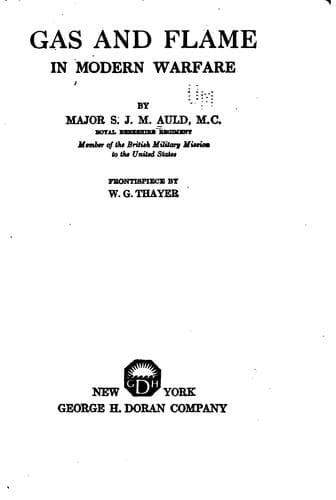
Gas and flame in modern warfareAuld, Samuel James Manson
History
Gas and flame in modern warfare
Auld, Samuel James Manson
Chemical warfare; Flame throwers; Gases, Asphyxiating and poisonous -- War use
Now imagine instead of ordinary shell that a number of gas shell had
been dropped into this busy centre. On a dark night, probably very
muddy underfoot and with all the excitement of kicking mules, flares
going up and anything from machine-gun bullets at long range to shell
of every size dropping in or expected, things are difficult enough. But
with the advent of the gas shell every man must get himself protected.
It is now that the “hold the breath, and mask on in six seconds” stunt
is going to be of value. With well-trained troops the losses from the
gas may be negligible, and it is equally true that they will be heavy
if the discipline is poor. But whether one way or the other it means
that all the frightened horses and mules must next be fixed with their
respirators and the work in hand must be proceeded with by everybody
while wearing gas masks. This is the real test.
If the men are well trained the carrying parties--perhaps with loads
of barbed wire on their backs--will get away as before and proceed up
the filthy communication trench to the front line; swearing probably,
uncomfortable certainly, but safe. Similarly the drivers will be
able to get their teams away from the gassed area as soon as they are
unloaded, and the serving out of the supplies will go on as before,
though at a reduced rate. But if the soldiers were not able to carry
on in these terrific circumstances--could not wear masks for long
periods and could not do anything in them--confusion would undoubtedly
supervene and the work be brought to a standstill. If this happened
the men in the front line next day would be short of rations, of
ammunition, of wire. They would, in fact, be neutralised.
It is attempted neutralisation of artillery and infantry by methods
such as these, carried out over large selected areas and generally as
a preface to an attack--either their own or ours--which constitutes
the German “fire for effect.” The “harassing fire” is simply the same
thing on a smaller scale and with no immediate tactical reason at the
back of it except that of killing and general annoyance. As a rule a
sudden burst of a few shell will be landed on some likely place, such
as the entrance to a communication trench, a sunken road, a bridge or
an observation post. These small shoots were always causing us a few
casualties. There was no warning, or somebody was not quick enough, or
did not get his respirator on, or took it off too soon. There would
always be some reason--but in the end it would generally come down to
something that the disciplinary thumbscrew could cure.
It is almost unbelievable nowadays that at one time one of the chief
sources of these constantly occurring casualties was shame-facedness at
being seen in a mask. Men would not protect themselves until absolutely
forced to do so, for fear others would regard them as being too easily
frightened. This was especially the case with new comers, who did not
want to drop in the estimation of the older hands.
Public-domain text, read in full here on John Shaqi.
Reviews
Reviews
No reviews yet
Be the first to share your thoughts on this work.
Elsewhere in the archive
Join the Discussion
Join the discussion
Sign in to leave a comment or review.
Sign InorCreate an account