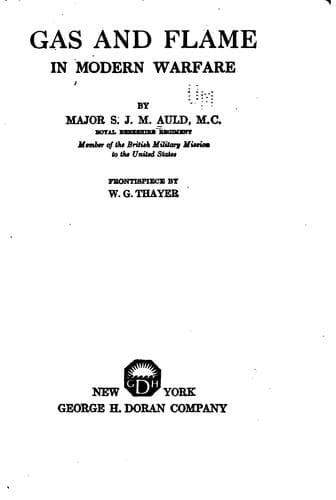
Gas and flame in modern warfareAuld, Samuel James Manson
History
Gas and flame in modern warfare
Auld, Samuel James Manson
Chemical warfare; Flame throwers; Gases, Asphyxiating and poisonous -- War use
It must be remembered that there are certain things that gas shell
cannot do. They cannot replace high-explosive shell for the demolition
of fortified works, for example. Nor can they be used for cutting
barbed wire previous to an advance; and the creeping barrage that
preceded the assaulting infantry cannot be made up by gas shell. An
S O S barrage in No Man’s Land, to cut up an attack, also would have
to be shrapnel and H. E. so as not to gas the defending troops. When
all these are cut out it will be realised that the proportion of gas
shell that are used against living targets must be very big indeed. It
is hardly too much to assert that at the present day, of the actual
methods of attacking men direct gas is the most important. It must be
realised also that it can become, and is likely to become, still more
important, and that the fight between the offence and the defence on
both sides will continue until the end of the war.
Since December of last year the boche has been copying a method
invented by the British for firing a large number of big drums of gas
simultaneously. These drums are used chiefly against the front-line
troops and are generally filled with pure phosgene. As each bomb
contains a gallon and a half of liquid and many hundreds are fired at
the same moment a good high concentration of gas is produced. Warning
is given by the tremendous roar from behind the German lines when the
flock of canister or rum-jar bombs starts on its way. Every man who
hears the noise gets his mask on at once, even before there is any sign
of gas; and if he does this there is little danger, as the respirators
are quite capable of dealing with even the very high concentrations
of phosgene produced. If a man keeps his head and obeys orders there
is little to fear from gas. But discipline must be high. As one Tommy
said: “You must be so well disciplined that when the gas alarm goes you
will even drop the rum ration so as to get your respirator on in time.”
Beyond that it is simply a question of carrying on the work in hand
while wearing a respirator, and this is entirely a matter of practice.
CHAPTER X
Liquid Fire--First used by Germans in July, 1915--A great
surprise and success--German hopes from it--Construction of
a flame projector--Flammenwerfer companies--Their perilous
duties and incidents of desertion from them--Improved types of
projectors--Co-operation of machine-gun fire--Failure of liquid
fire--Its short duration and short range--Ease of escape from it.
When the German Army entered on its policy of frightfulness there was
none of its new and unprincipled methods which had more immediate and
striking success than the use of liquid fire. And there is now none of
all its methods of frightfulness which has fallen more into disrepute,
and which has had less success when once the first surprise was over.
Public-domain text, read in full here on John Shaqi.
Reviews
Reviews
No reviews yet
Be the first to share your thoughts on this work.
Elsewhere in the archive
Join the Discussion
Join the discussion
Sign in to leave a comment or review.
Sign InorCreate an account