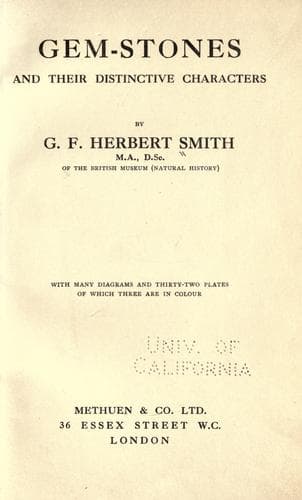
Gem-Stones and Their Distinctive CharactersSmith, George Frederick Herbert
Science
Gem-Stones and Their Distinctive Characters
Smith, George Frederick Herbert
Precious stones
In composition corundum is alumina, oxide of aluminium, corresponding
to the formula Al_{2}O_{3}, but it usually contains in addition small
quantities, rarely more than 1 per cent., of ferric oxide, chromic
oxide, and perhaps other metallic oxides. When pure, it is colourless;
the splendid tints which are its glory have their origin in the minute
traces of the other oxides present. No doubt chromic oxide is the
cause of the ruddy hue of ruby, since it is possible, as explained
above (p. 117), closely to imitate the ruby tint by this means, but
nothing approaching so large a percentage as 2½ has been detected in
a natural stone. The blue colour of sapphire may be due to titanic
oxide, and ferric oxide may be responsible for the yellow hue of
the ‘oriental topaz,’ as the yellow corundum is termed. Sapphires,
when of considerable size, are rarely uniform in tint throughout the
stone. Alternations of blue and red zones, giving rise to an apparent
purple or violet tint, and the conjunction of patches of blue and
yellow are common. Perfectly colourless stones are less common, a
slight bluish tinge being usually noticeable, but they are not in much
demand because, on account of their lack of ‘fire,’ they are of little
interest when cut. The tint of the red stones varies considerably in
depth; jewellers term them, when pale, pink sapphires, but, of course,
no sharp distinction can be drawn between them and rubies. The most
highly prized tint is the so-called pigeon’s blood, a shade of red
slightly inclined to purple. The prices for ruby of good colour run
from about 25s. a carat for small stones to between £60 and £80 a
carat for large stones, and still higher for exceptional rubies. The
taste in sapphires has changed of recent times. Formerly the deep blue
was most in demand, but now the lighter shade, that resembling the
colour of corn-flower, is preferred, because it retains a good colour
in artificial light. Large sapphires are more plentiful than large
rubies, and prices run lower; even for large perfect stones the rate
does not exceed £30 a carat. Large and uniform ‘oriental topazes’ are
comparatively common, and realize moderate prices, about 2s. to 30s.
a carat according to quality and size. Green sapphires are abundant
from Australia, but their tint, a kind of deep sage-green, is not very
pleasing. Brown stones with a silkiness of structure are also known.
Public-domain text, read in full here on John Shaqi.
Reviews
Reviews
No reviews yet
Be the first to share your thoughts on this work.
Elsewhere in the archive
Join the Discussion
Join the discussion
Sign in to leave a comment or review.
Sign InorCreate an account