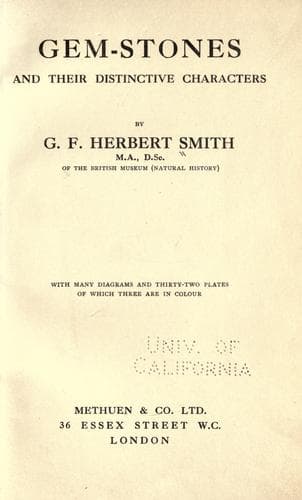
Gem-Stones and Their Distinctive CharactersSmith, George Frederick Herbert
Science
Gem-Stones and Their Distinctive Characters
Smith, George Frederick Herbert
Precious stones
Large rubies are far from common, and such as were discovered in the
old days were jealously hoarded by the Burmese sovereigns. According to
Streeter the finest that ever came to Europe were a pair brought over
in 1875, at a time when the Burmese king was pressed for money. One,
rich in colour, was originally cushion-shaped and weighed 37 carats;
the other was a blunt drop in form and weighed 47 carats. Both were cut
in London, the former being reduced to 32-5/16 carats and the latter
to 38-9/16 carats, and were sold for £10,000 and £20,000 respectively.
A colossal stone, weighing 400 carats, is reported to have been found
in Burma; it was broken into three pieces, of which two were cut and
resulted in stones weighing 70 and 45 carats respectively, and the
third was sold uncut in Calcutta for 7 lakhs of rupees (£46,667). The
finder of another large stone broke it into two parts, which after
cutting weighed 98 and 74 carats respectively; he attempted in vain to
evade the royal acquisitiveness, by giving up the larger stone to the
king and concealing the other. A fine stone, known by the formidable
appellation of ‘Gnaga Boh’ (Dragon Lord), weighed 44 carats in the
rough and 20 carats after cutting. Since the mines were taken over
by the Ruby Mines, Ltd., a few large stones have been discovered. A
beautiful ruby was found in the Tagoungnandaing Valley, and weighed
18½ carats in the rough and 11 carats after cutting; perfectly clear
and of splendid colour, it was sold for £7000, but is now valued at
£10,000. Another, weighing 77 carats in the rough, was found in 1899,
and was sold in India in 1904 for 4 lakhs of rupees (£26,667). A stone,
weighing 49 carats, was discovered in 1887, and an enormous one,
weighing as much as 304 carats, in 1890.
The ruby, as large as a pigeon’s egg, which is amongst the Russian
regalia was presented in 1777 to the Czarina Catherine by Gustav III of
Sweden when on a visit to St. Petersburg. The large red stone in the
English regalia which was supposed to be a ruby is a spinel (cf p. 206).
Comparatively uncommon as sapphires are in the Burma mines a faultless
stone, weighing as much as 79½ carats, has been discovered there.
Public-domain text, read in full here on John Shaqi.
Reviews
Reviews
No reviews yet
Be the first to share your thoughts on this work.
Elsewhere in the archive
Join the Discussion
Join the discussion
Sign in to leave a comment or review.
Sign InorCreate an account