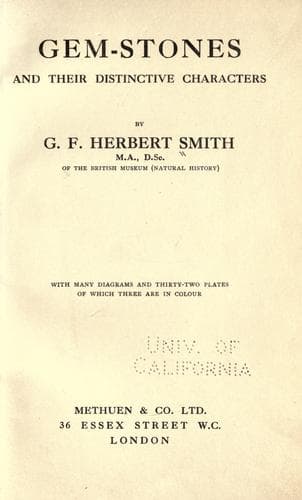
Gem-Stones and Their Distinctive CharactersSmith, George Frederick Herbert
Science
Gem-Stones and Their Distinctive Characters
Smith, George Frederick Herbert
Precious stones
The ever great demand and the essentially restricted supply have forced
the cost of emeralds of good quality to a height that puts large stones
beyond the reach of all but a privileged few who have purses deep
enough. The rate per carat may be anything from £15 upwards, depending
upon the purity of the colour and the freedom from flaws, but it
increases very rapidly with the size, since flawless stones of more
than 4 carats or so in weight are among the rarest of jewels; a perfect
emerald of 4 carats may easily fetch £1600 to £2000. It seems anomalous
to say that it has never been easier to procure fine stones than during
recent years, but the reason is that the high prices prevailing have
tempted owners of old jewellery to realize their emeralds. On the other
hand, pale emeralds are worth only a nominal sum.
The other varieties of beryl are much less rare, and, since they
usually attain to more considerable, and sometimes even colossal, size,
far larger stones are obtainable. An aquamarine, particularly of good
deep blue-green colour, is a stone of great beauty, and it possesses
the merit of preserving its purity of tint in artificial light. It is a
favourite stone for pendants, brooches, and bracelets, and all purposes
for which a large blue or green stone is desired. The varying tints are
said to be due to the presence of iron in different percentages, and
possibly in different states of oxidation. Unlike emerald, the other
varieties are by no means so easily recognized by their colour. Blue
aquamarines may easily be mistaken for topaz, or vice versa, and the
yellow beryl closely resembles other yellow stones, such as quartz,
topaz, or tourmaline. Stones which are colourless or only slightly
tinted command little more than the price of cutting, but the price of
blue-green stones rapidly advances with increasing depth of tint up
to £2 a carat. The enormous cut aquamarine which is exhibited in the
Mineral Gallery of the British Museum (Natural History), affords some
idea of the great size such stones reach; a beautiful sea-green in
colour, it weighs 179·5 grams (875 carats), and is table-cut with an
oval contour.
Public-domain text, read in full here on John Shaqi.
Reviews
Reviews
No reviews yet
Be the first to share your thoughts on this work.
Elsewhere in the archive
Join the Discussion
Join the discussion
Sign in to leave a comment or review.
Sign InorCreate an account