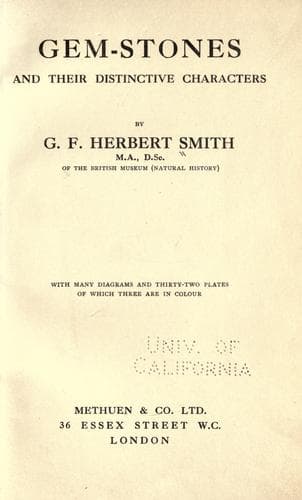
Gem-Stones and Their Distinctive CharactersSmith, George Frederick Herbert
Science
Gem-Stones and Their Distinctive Characters
Smith, George Frederick Herbert
Precious stones
The symmetry is orthorhombic, and the crystals are prismatic in shape
and terminated by numerous inclined faces, and usually by a large
face perpendicular to the prism edge (Fig. 72). Topaz cleaves with
great readiness at right angles to the prism edge; owing to its facile
cleavage, flaws are easily started, and caution must be exercised
not to damage a stone by knocking it against hard and unyielding
substances. The dichroism of a yellow topaz is always perceptible,
one of the twin colours being distinctly more reddish than the other,
and the phenomenon is very marked in the case of stones the colour of
which has been artificially altered to pink. The values of the least
and the greatest of the principal indices of refraction vary from 1·615
to 1·629, and from 1·625 to 1·637, respectively, the double refraction
being about 0·010 in amount, and positive in sign. The high values
correspond to the altered stones. The specific gravity, the mean value
of which is 3·55 with a variation of 0·05 on either side, is higher
than would be expected from the refractivity. A cleavage flake exhibits
in convergent polarized light a wide-angled biaxial picture, the ‘eyes’
lying outside the field of view. The relation of the principal optical
directions and the directions of single refraction to the crystal
are shown in Fig. 27. The hardness is 8 on Mohs’s scale, and in this
character it is surpassed only by chrysoberyl, corundum, and diamond.
Topaz is pyro-electric, in which respect tourmaline alone exceeds it,
and it may be strongly electrified by friction.
Although the range of refraction overlaps that of tourmaline, there
is no risk of confusion, because the latter has nearly thrice the
amount of double refraction (cf. p. 29). Apart from the difference in
refraction, a yellow topaz ought never to be confused with a yellow
quartz, because the former sinks, and the latter floats in methylene
iodide. The same test distinguishes topaz from beryl, and, indeed, from
tourmaline also.
Judged by the criterion of price, topaz is not in the first rank of
precious stones. Stones of good colour and free from flaws are now,
however, scarce. Pale stones are worth very little, possibly less than
4s. a carat, but the price rapidly advances with increase in colour,
reaching 20s. for yellow, 80s. for pink and blue stones. Since topazes
are procurable in all sizes customary in jewellery, the rates vary but
slightly, if at all, with the size.
Public-domain text, read in full here on John Shaqi.
Reviews
Reviews
No reviews yet
Be the first to share your thoughts on this work.
Elsewhere in the archive
Join the Discussion
Join the discussion
Sign in to leave a comment or review.
Sign InorCreate an account