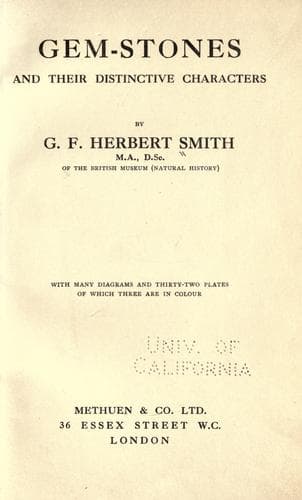
Gem-Stones and Their Distinctive CharactersSmith, George Frederick Herbert
Science
Gem-Stones and Their Distinctive Characters
Smith, George Frederick Herbert
Precious stones
Garnet belongs to the cubic system of crystalline symmetry.
Its crystals are commonly of two kinds, both of which are very
characteristic, the regular dodecahedron, _i.e._ twelve-faced figure
(Fig. 75), and the tetrakis-octahedron or three-faced octahedron (Fig.
76); the latter crystals are, especially when weather- or water-worn,
almost spherical in shape. Closer and more refined observations have
shown that garnet is seldom homogeneous, being usually composed of
several distinct individuals of a lower order of symmetry. Although
singly refractive as far as can be determined with the refractometer or
by deviation through a prism, yet when examined under the polarizing
microscope, garnets display invariably a small amount of local double
refraction. The transition from light to darkness is, however, not
sharp as in normal cases, but is prolonged into a kind of twilight.
In hardness, garnet is on the whole about the same as quartz, but
varies slightly; hessonite and andradite are a little softer, pyrope,
spessartite, and almandine are a little harder, while uvarovite is
almost the same. All the varieties except uvarovite are fusible when
heated before the blowpipe, and small fragments melt sufficiently on
the surface in the ordinary bunsen flame to adhere to the platinum
wire holding them. This test is very useful for separating rough red
garnets, pyrope or almandine, from red spinels or zircons of very
similar appearance. Far greater variation occurs in the other physical
characters. The specific gravity may have any value between 3·55 and
4·20, and the refractive index ranges between 1·740 and 1·890. Both the
specific gravity and the refractive index increase on the whole with
the percentage amount of iron.
Garnet is a prominent constituent of many kinds of rocks, but the
material most suitable for gem purposes occurs chiefly in crystalline
schists or metamorphic limestones. Pyrope and demantoid are furnished
by peridotites and the serpentines resulting from them; almandine and
spessartite come mostly from granites.
The name of the species is derived from the Latin _granatus_,
seed-like, and is suggested by the appearance of the spherical crystals
when embedded in their pudding-like matrix.
Public-domain text, read in full here on John Shaqi.
Reviews
Reviews
No reviews yet
Be the first to share your thoughts on this work.
Elsewhere in the archive
Join the Discussion
Join the discussion
Sign in to leave a comment or review.
Sign InorCreate an account