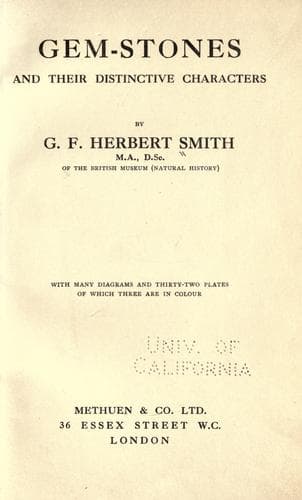
Gem-Stones and Their Distinctive CharactersSmith, George Frederick Herbert
Science
Gem-Stones and Their Distinctive Characters
Smith, George Frederick Herbert
Precious stones
Tourmaline is unsurpassed even by corundum in variety of hue, and
it has during recent years rapidly advanced in public favour,
mainly owing to the prodigal profusion in which nature has formed
it in that favoured State, California, the garden of the west. Its
comparative softness militates against its use in rings, but its
gorgeous coloration renders it admirably fitted for service in any
article of jewellery, such as a brooch or a pendant, in which a large
central stone is required. Like all coloured stones it is generally
brilliant-cut in front and step-cut at the back, but occasionally it is
sufficiently fibrous in structure to display, when cut _en cabochon_,
pronounced chatoyancy.
The composition of this complex species has long been a vexed
question among mineralogists, but considerable light was
recently thrown on the subject by Schaller, who showed that all
varieties of tourmaline may be referred to a formula of the type
12SiO_{2}.3B_{2}O_{3}.(9-_x_)[(Al,Fe)_{2}O_{3}].3_x_[(Fe,Mn,Ca,
Mg,K_{2},Na_{2},Li_{2},H_{2})O].3H_{2}O. The ratios of boric oxide,
silica, and water are nearly constant in all analyses, but great
variation is possible in the proportions of the other constituents.
Having regard to this complexity, it is not surprising to find that
the range in colour is so great. Colourless stones, to which the name
achroite is sometimes given, were at one time exceedingly rare, but
they are now found in greater number in California. Stones which are
most suited to jewellery purposes are comparatively free from iron, and
apparently owe their wonderful tints to the alkaline earths; lithia,
for instance, is responsible for the beautiful tint of the highly
prized rubellite, and magnesia, no doubt, for the colour of the brown
stones of various tints. Tourmaline rich in iron is black and almost
opaque. It is a striking peculiarity of the species that the crystals
are rarely uniform in colour throughout, the boundaries between the
differently coloured portions being sharp and abrupt, and the tints
remarkably in contrast. Sometimes the sections are separated by planes
at right angles to the length of the crystal, and sometimes they are
zonal, bounded by cylindrical surfaces running parallel to the same
length. In the latter case a section perpendicular to the length shows
zones of at least three contrasting tints. In the Brazilian stones the
core is generally red, bounded by white, with green on the exterior,
while the reverse is the case in the Californian stones, the core being
green or yellow, bounded by white, with red on the exterior. Tourmaline
may, indeed, be found of almost every imaginable tint, except,
perhaps, the emerald green and the royal sapphire-blue. The principal
varieties are rose-red and pink (rubellite) (Plate XXVII, Fig. 1),
green (Brazilian emerald), indigo-blue (indicolite), blue (Brazilian
sapphire), yellowish green (Brazilian peridot) (Plate XXVII, Fig. 2),
Public-domain text, read in full here on John Shaqi.
Reviews
Reviews
No reviews yet
Be the first to share your thoughts on this work.
Elsewhere in the archive
Join the Discussion
Join the discussion
Sign in to leave a comment or review.
Sign InorCreate an account