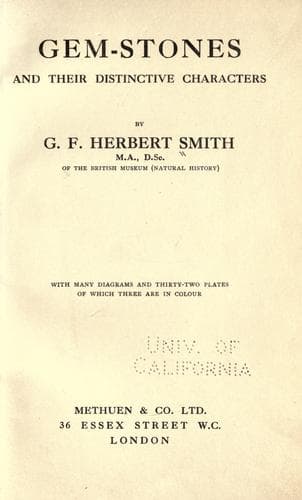
Gem-Stones and Their Distinctive CharactersSmith, George Frederick Herbert
Science
Gem-Stones and Their Distinctive Characters
Smith, George Frederick Herbert
Precious stones
tourmaline is remarkable, although of little value as a test in the
case of a cut stone, is of great scientific interest, because it is
strong evidence of the peculiar crystalline symmetry pertaining to its
molecular arrangement. Tourmalines range in price from 5s. to 20s. a
carat according to their colour and quality, but exceptional stones may
command a higher rate.
Tourmaline is usually found in the pegmatite dykes of granites, but
it also occurs in schists and in crystalline limestones. Rubellite
is generally associated with the lithia mica, lepidolite; the groups
of delicate pink rubellite bespangling a background of greyish
white lepidolite are among the most beautiful of museum specimens.
Magnificent crystals of pink, blue, and green tourmaline have been
found in the neighbourhood of Ekaterinburg, principally at Mursinka, in
the Urals, Russia, and fine rubellite has come from the Urulga River,
and other spots near Nertschinsk, Transbaikal, Asiatic Russia. Elba
produces pink, yellowish, and green stones, frequently particoloured;
sometimes the crystals are blackened at the top, and are then known
locally as ‘nigger-heads.’ Ceylon supplies small yellow stones—the
original tourmaline—which are confused with the zircon of a similar
colour, and rubellite accompanies the ruby at Ava, Burma. Beautiful
crystals, green and red, often diversely coloured, come from various
parts, such as Minas Novas and Arassuahy, of the State of Minas Geraes,
Brazil. Suitable gem material has been found in numerous parts of
the United States. Paris and Hebron in Maine have produced gorgeous
pink and green crystals, and Auburn in the same state has supplied
deep-blue, green, and lilac stones. Fine crystals, mostly green, but
also pink and particoloured, occur in an albite quarry near the Conn
River at Haddam Neck, Connecticut. All former localities have, however,
been surpassed by the extraordinary abundance of superb green, and
especially pink, crystals at Pala and Mesa Grande in San Diego County,
California. As elsewhere, many-hued stones are common. The latter
locality supplies the more perfectly transparent crystals. Kunz states
that two remarkable rubellite crystals were found there, one being 45
mm. in length and 42 mm. in diameter, and the other 56 mm. in length
and 24 mm. in diameter. Madagascar, which has proved of recent years
to be rich in gem-stones, supplies green, yellow, and red stones, both
uniformly tinted and particoloured, which in beauty, though perhaps not
in size, bear comparison with any found elsewhere.
CHAPTER XXV
PERIDOT
Public-domain text, read in full here on John Shaqi.
Reviews
Reviews
No reviews yet
Be the first to share your thoughts on this work.
Elsewhere in the archive
Join the Discussion
Join the discussion
Sign in to leave a comment or review.
Sign InorCreate an account