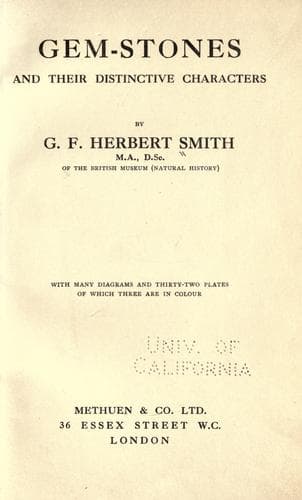
Gem-Stones and Their Distinctive CharactersSmith, George Frederick Herbert
Science
Gem-Stones and Their Distinctive Characters
Smith, George Frederick Herbert
Precious stones
variation occurs in the specific gravity, namely, from 3·3 to 3·5.
[Illustration: _PLATE XXVII_
1. RUBELLITE
2. TOURMALINE
3. BALAS-RUBY
4. BLUE SPINEL
5. QUARTZ
6. WHITE OPAL
7. AMETHYST
8. TOURMALINE
9. BLACK OPAL
10. FIRE OPAL
11. ALEXANDRITE (_By daylight_)
12. CHRYSOBERYL
13. ALEXANDRITE (_By artificial light_)
GEM-STONES]
Peridots of deep bottle-green hue command moderate prices at the
present day, about 30s. a carat being asked for large stones; the paler
tinted stones run down to a few shillings a carat. The rate per carat
may be very much larger for stones of exceptional size and quality.
Olivine, to use the ordinary mineralogical term, is a common and
important constituent of certain kinds of igneous rocks, and it is
also found in those strange bodies, meteorites, which come to us
from outer cosmical space. Except in basaltic lavas, it occurs in
grains and rarely in well-shaped crystals. Stones that are large and
transparent enough for cutting purposes come almost entirely from the
island Zebirget or St. John situated on the west coast of the Red Sea,
opposite to the port of Berenice. This island belongs to the Khedive of
Egypt, and is at present leased to a French syndicate. It is believed
to be the same as the mysterious island which produced the ‘topaz’
of Pliny’s time. Magnificent stones have been discovered here, rich
green in colour, and 20 to 30, and occasionally as much as 80, carats
in weight when cut; a rough mass attained to the large weight of 190
carats. Pretty, light-green stones are supplied by Queensland, and
peridots of a less pleasing dark-yellowish shade of green, and without
any sign of crystal form, have during recent years come from North
America. Stones rather similar to those from Queensland have latterly
been found in the Bernardino Valley in Upper Burma, not far from the
ruby mines.
CHAPTER XXVI
ZIRCON
(_Jargoon_, _Hyacinth_, _Jacinth_)
Zircon, which, if known at all in jewellery, is called by its variety
names, jargoon and hyacinth or jacinth, is a species that deserves
greater recognition than it receives. The colourless stones rival
even diamond in splendour of brilliance and display of ‘fire’; the
leaf-green stones (Plate XXIX, Fig. 13) possess a restful beauty
that commends itself; the deep-red stones (Plate XXIX, Fig. 14), if
somewhat sombre, have a certain grandeur; and no other species produces
such magnificent stones of golden-yellow hue (Plate XXIX, Fig. 12).
Zircon is well known in Ceylon, which supplies the world with the
finest specimens, and is highly appreciated by the inhabitants of that
sunny isle, but it scarcely finds a place in jewellery elsewhere. The
colourless stones are cut as brilliants, but brilliant-cut fronts with
step-cut backs is the usual style adopted for the coloured stones.
Public-domain text, read in full here on John Shaqi.
Reviews
Reviews
No reviews yet
Be the first to share your thoughts on this work.
Elsewhere in the archive
Join the Discussion
Join the discussion
Sign in to leave a comment or review.
Sign InorCreate an account