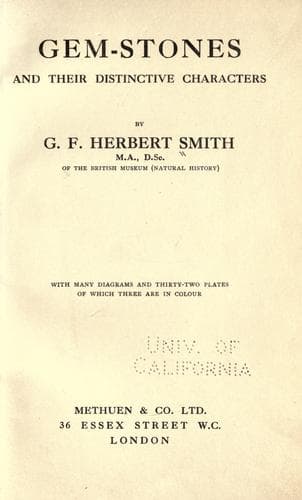
Gem-Stones and Their Distinctive CharactersSmith, George Frederick Herbert
Science
Gem-Stones and Their Distinctive Characters
Smith, George Frederick Herbert
Precious stones
Opal is colourless when pure, but is nearly always more or less milky
and opaque, or tinted various dull shades by ferric oxide, magnesia
or, alumina. The so-called black opal is generally a dark grey or
blue, and very rarely quite black. That the coloration is not due
to ordinary absorption, but to the action of cracks in the stone,
is shown by the fact that the transmitted light is complementary to
the reflected light; the blue opal is, for instance, a yellow when
held up so that light has passed through it. In many black opals the
opalescent material occurs in far too tiny pieces to be cut separately,
and the whole iron-stained matrix is cut and polished and sold under
the name ‘opal-matrix.’ The reddish and orange-coloured stones known
as fire-opal have pronounced colour and only slight milkiness; they
display the customary opalescence in certain directions. These stones
are often faceted, but otherwise opals are cut _en cabochon_, either
flat or steep—generally the former in brooches and pendants, and the
latter in rings. Opal is somewhat soft, varying from 5 to 6½ on Mohs’s
scale, and is therefore easily scratched. The specific gravity ranges
from 2·10 to 2·20, and the refractive index from 1·444 to 1·464, the
refraction, of course, being always single. It is unwise to immerse
opals in liquids on account of their porosity.
The name opal comes to us through the Latin _opallus_, which was used
for the same species as understood by the term at the present day, but
the word has a far older origin, which has not been traced. The Romans
also called the mineral _pæderos_, the Greek form of Cupid, a name
applied to all rosy stones. The name cacholong, for the bluish-white
porcelain variety, which is very porous and adheres to the tongue, is
of Tartar origin; the stone is highly valued in the East.
Public-domain text, read in full here on John Shaqi.
Reviews
Reviews
No reviews yet
Be the first to share your thoughts on this work.
Elsewhere in the archive
Join the Discussion
Join the discussion
Sign in to leave a comment or review.
Sign InorCreate an account