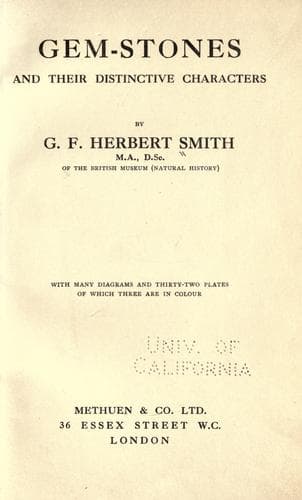
Gem-Stones and Their Distinctive CharactersSmith, George Frederick Herbert
Science
Gem-Stones and Their Distinctive Characters
Smith, George Frederick Herbert
Precious stones
Transparent crystals have come from Knappenwand, Untersulzbachtal,
Salzburg, Austria; Traversella, Piedmont, Italy; and Arendal, Nedenäs,
Norway. Magnificent, but very dark, crystals were discovered about ten
years ago on Prince of Wales Island, Alaska.
SPHENE
(_Titanite_)
The clear, green, yellow, or brownish stones provided by this species
would be welcomed in jewellery because of their brilliant and
almost adamantine lustre, but, unfortunately, they are too soft to
withstand much wear, the hardness being only 5½ on Mohs’s scale. In
composition sphene is a silico-titanate of calcium corresponding to
the formula CaTiSiO_{5}, and in this respect comes near the recently
discovered gem-stone, benitoite. The refractive indices lie outside
the range of the refractometer, the values of the least and the
greatest of the refractive indices varying from 1·888 and 1·917 to
1·914 and 2·053 respectively. It is to this high refraction that it
owes its brilliant lustre. The double refraction, which is biaxial in
character and positive in sign, is so large that the apparent doubling
of the opposite edges of a cut stone when viewed through one of the
faces is obvious to the unaided eye (cf. p. 41). Cut stones have
additional interest on account of the vivid dichroism displayed, the
twin-tints, colourless, yellow, and reddish yellow, corresponding to
the three principal optical directions, being in strong contrast. The
specific gravity ranges from 3·35 to 3·45. The negative test with the
refractometer (cf p. 26), the softness, and the large amount of double
refraction suffice to distinguish this species from gem-stones of
similar appearance.
The name sphene, from σφήν, wedge, alludes to the shape of the natural
crystals. The alternative name is obviously due to the fact that the
species contains titanium.
Good stones have come from the St. Gothard district, Switzerland.
AXINITE
Called axinite from the shape of its crystals—ἀξίνη, axe—this species
supplies small, clear, clove-brown, honey-yellow, and violet stones
which can be cut for those who care for a stone out of the ordinary.
The composition is a boro-silicate of aluminium and calcium, with
varying amounts of iron and manganese, corresponding to the formula
(Ca,Fe)_{3}Al_{2}(B.OH)Si_{4}O_{15}. Axinite is interesting on
account of its strong dichroism, the twin-tints corresponding to the
principal optical directions being violet, brown, and green. The double
refraction is biaxial in character and negative in sign, the least and
greatest of the refractive indices being 1·674 and 1·684; the specific
gravity is 3·28, and hardness about 6½ to 7, or rather under that of
quartz.
The best examples have been found at St. Cristophe, Bourg d’Oisans, in
the Dauphiné, France. Violet axinite is a novelty that has come within
recent years from Rosebery, Montagu County, Tasmania.
Public-domain text, read in full here on John Shaqi.
Reviews
Reviews
No reviews yet
Be the first to share your thoughts on this work.
Elsewhere in the archive
Join the Discussion
Join the discussion
Sign in to leave a comment or review.
Sign InorCreate an account