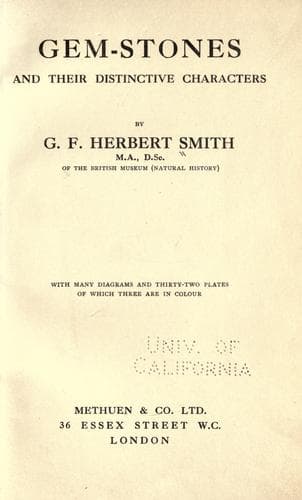
Gem-Stones and Their Distinctive CharactersSmith, George Frederick Herbert
Science
Gem-Stones and Their Distinctive Characters
Smith, George Frederick Herbert
Precious stones
CHAPTER XXXVII
CASSITERITE, ANATASE, PYRITES, HEMATITE
CASSITERITE
Though usually opaque, this oxide of tin, corresponding to the formula
SnO_{2}, has occasionally, but very rarely, been found in small,
transparent, yellow and reddish stones suitable for cutting. The lustre
is adamantine. The refraction is uniaxial in character and positive
in sign, the ordinary index being 1·997 and extraordinary 2·093. The
specific gravity is high, ranging from 6·8 to 7·1. The hardness is on
the whole less than that of quartz, being about 6 to 7 on Mohs’s scale.
ANATASE
This mineral, which is one of the three crystallized forms of titanium
oxide, TiO_{2}, occurs often in small, brown, transparent stones which
occasionally find their way into the market. The lustre is adamantine.
The refraction is uniaxial in character and negative in sign, the
extraordinary index being 2·493 and ordinary 2·554. The specific
gravity varies from 3·82 to 3·95, and the hardness is about 5½ to 6 on
Mohs’s scale.
PYRITES, HEMATITE
These two metallic minerals were employed in ancient jewellery. The
former, sulphide of iron, FeS_{2}, is brass-yellow in colour, and has
a specific gravity 5·2, and hardness 6½ on Mohs’s scale. It is found,
when fresh, in brilliant cubes. The latter, oxide of iron, Fe_{2}O_{3},
has a black metallic lustre, but, when powdered, is red in colour—a
mode of distinguishing it from other minerals of similar appearance.
Its specific gravity is 5·3, and hardness 6½ on Mohs’s scale. In modern
times it has been cut in spherical form to imitate black pearls, but
can easily be recognized by its greater density and hardness. Hematite
is used for signet stones, often with an intaglio engraving.
CHAPTER XXXVIII
OBSIDIAN, MOLDAVITE
Two forms of natural glass have been employed for ornamental purposes.
Obsidian results from the solidification without crystallization of
lava, and corresponds in composition to a granite. The structure
is seldom clear and transparent, and usually contains inclusions
or streaks. The colour is in the mass jet-black, but smoky in thin
fragments, and occasionally greenish. Its property of breaking with a
keen cutting edge, in the same way as ordinary glass, rendered it of
extreme utility to primitive man, who was ignorant of the artificial
substance. The refraction is, of course, single, and the refractive
index approximates to 1·50. The specific gravity varies from 2·3 to
2·5. The hardness is 5 on Mohs’s scale, the same as ordinary glass.
Obsidian is obtained wherever there has been volcanic activity. Vast
mines of great antiquity exist in the State of Hidalgo, Mexico.
Public-domain text, read in full here on John Shaqi.
Reviews
Reviews
No reviews yet
Be the first to share your thoughts on this work.
Elsewhere in the archive
Join the Discussion
Join the discussion
Sign in to leave a comment or review.
Sign InorCreate an account