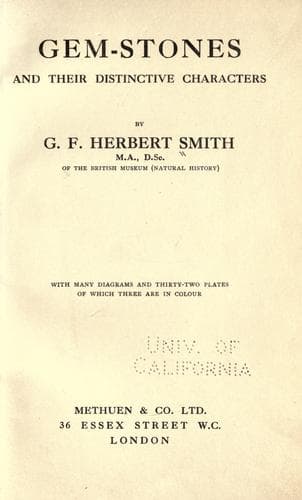
Gem-Stones and Their Distinctive CharactersSmith, George Frederick Herbert
Science
Gem-Stones and Their Distinctive Characters
Smith, George Frederick Herbert
Precious stones
Although none of the substances considered in this chapter come within
the strict definition of a stone, since they are directly the result of
living agency, yet pearl at least cannot be denied the title of a gem.
Both pearl and coral contain calcium carbonate in one or other of its
crystallized forms, and both are gathered from the sea; but otherwise
they have nothing in common. Amber is of vegetable origin, and is a
very different substance.
PEARL
From that unrecorded day when some scantily clothed savage seeking for
succulent food opened an oyster and found to his astonishment within
its shell a delicate silvery pellet that shimmered in the light of a
tropical sun, down to the present day, without intermission, pearl has
held a place all its own in the rank of jewels. Though it be lacking in
durability, its beauty cannot be disputed, and large examples, perfect
in form and lustre, are sufficiently rare to tax the deepest purse.
The substance composing the pearl is identical with the iridescent
lining—mother-o’-pearl or nacre, as it is termed—of the shell.
Tortured by the intrusion of some living thing, a boring parasite,
a worm, or a small fish, or of a grain of sand or other inorganic
substance, and without means to free itself, the mollusc perforce
neutralizes the irritant matter by converting it into an object of
beauty that eventually finds its way into some jewellery cabinet. Built
up in a haphazard manner and not confined by the inexorable laws of
intermolecular action, a pearl may assume any and every variety of
shape from the regular to the fantastic. It may be truly spherical,
egg- or pear-shaped—pear-drops or pear-eyes, as they are termed—or it
may be quite irregular—the so-called baroque or barrok pearls. The
first is the most prized, but a well-shaped drop-pearl is in great
demand for pendants or ear-rings. The colour is ordinarily white, or
faintly tinged yellowish or bluish, and somewhat rarely, salmon-pink,
reddish, or blackish grey. Perfect black pearls are valuable, but not
as costly as the finest of the white. Though not transparent, pearl is
to a varying extent translucent, and its characteristic lustre—‘orient’
in the language of jewellery—is due to the same kind of interaction
of light reflected from different layers that has been remarked upon
in the case of opal and certain other stones. The translucency varies
in degree, and some jewellers speak of the ‘water’ of pearls just as
in the case of diamonds. If a pearl be sliced across the middle and
the section be examined under the microscope, it will be seen that
the structure consists of concentric shells and resembles that of an
onion. These shells are alternately composed of calcium carbonate in
its crystallized form, aragonite, and of a horny organic matter known
as conchiolin, and they evidently represent the result of intermittent
growth. Because of their composite character, pearls have a specific
Public-domain text, read in full here on John Shaqi.
Reviews
Reviews
No reviews yet
Be the first to share your thoughts on this work.
Elsewhere in the archive
Join the Discussion
Join the discussion
Sign in to leave a comment or review.
Sign InorCreate an account